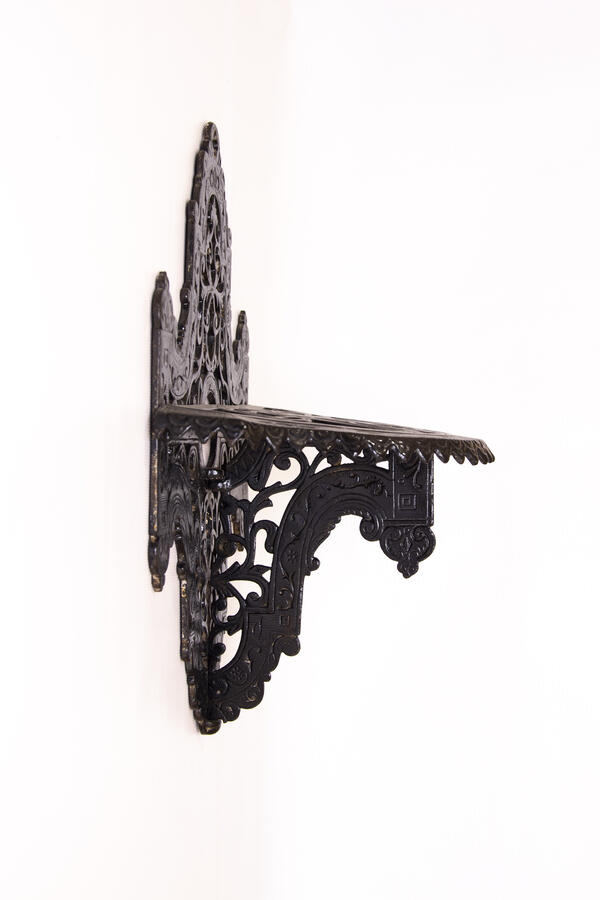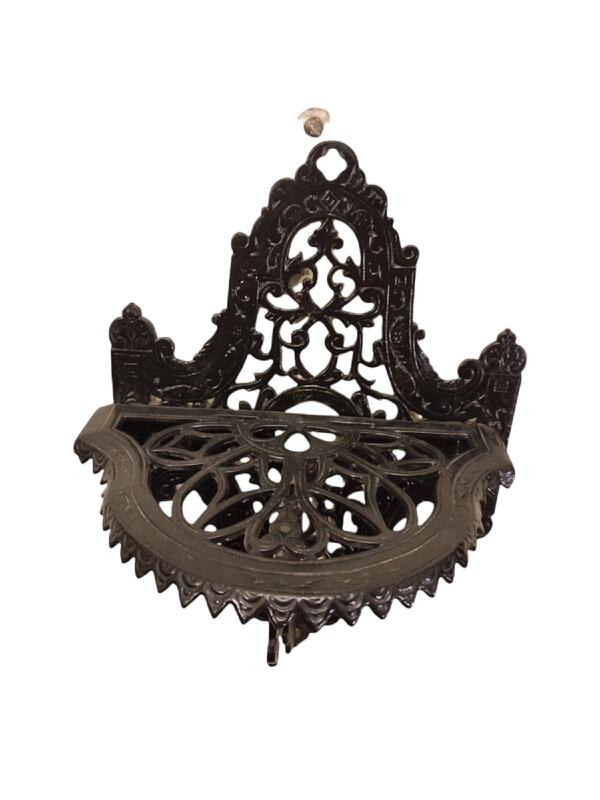
This neo-Russian shelf is a well-preserved example of decorative and applied art of the early 20th century. Judging by the stamp on the back of the base “Kus. Z. Z. S. No. 7 ” and the two-headed eagle above it, the shelf was made at the Kusinsky state-owned plant. S.P. Nikolaev, a resident of Tyumen, donated this item to the museum.
According to the plant catalog “Price list for cast-iron office things of the Kusinsky state-owned plant for 1911”, the shelf is lot No. 351 listed under the name “Large semicircular openwork shelf (Russian style)”. The shelf weighs 3.5 pounds; its price was 65 kopecks for a painted shelf and 85 kopecks for a nickel-plated one. By today’s standards, the shelf is small.
The history of artistic casting at the Kusinsky plant began in 1815. At first the artisans cast stove accessories and dishes, then architectural and park decorations, and by the end of the 19th century, “office” interior goods. The shelf from the museum’s collection was, like other “office” items of the late 19th and early 20th centuries, created thanks to the experienced Zlatoust foundry craftsman Nikifor Mikhailovich Murzin. The artisan worked at the Kusinsky iron foundry from 1860 to 1916. During half a century of dedicated work, Nikifor Mikhailovich managed to teach the new generations of Kusinsky workers and artisans, to explain the secrets of manufacturing thin-walled dishes and furnace casting, and to get the business going. Thanks to good cast iron, the plant produced excellent Asian and Russian dishes and “office” items. Since 1882, production has concentrated on the manufacture of Russian dishes.
Nikifor Murrin helped the manager Cheslav Valerianovich Pantserzhinsky to transform the old foundry into a specialized art casting shop. To improve the quality of cast office items, Panzerzhinsky invited experienced molders Fyodor and Vasily Kuznetsov from Kasli, who were to “…accustom the workers of the Kusinsky plant assigned to us both to the accuracy of finishing things, and also to show them the molding technique in order to prepare as many objects as possible with the least rejection rate.” Casting samples were taken from the best sculptors in Moscow, St. Petersburg and even Europe. They were made mainly in Art Nouveau and neo-Russian styles.
Despite the great success and high artistic level, the Kusinsky plant has always been surpassed by the Kaslinsky plant because it was state-owned and the main products were for military purposes. As a result, with the outbreak of the First World War, the art of iron casting fell into decline: the plant was one of the main enterprises of the defense industry.
According to the plant catalog “Price list for cast-iron office things of the Kusinsky state-owned plant for 1911”, the shelf is lot No. 351 listed under the name “Large semicircular openwork shelf (Russian style)”. The shelf weighs 3.5 pounds; its price was 65 kopecks for a painted shelf and 85 kopecks for a nickel-plated one. By today’s standards, the shelf is small.
The history of artistic casting at the Kusinsky plant began in 1815. At first the artisans cast stove accessories and dishes, then architectural and park decorations, and by the end of the 19th century, “office” interior goods. The shelf from the museum’s collection was, like other “office” items of the late 19th and early 20th centuries, created thanks to the experienced Zlatoust foundry craftsman Nikifor Mikhailovich Murzin. The artisan worked at the Kusinsky iron foundry from 1860 to 1916. During half a century of dedicated work, Nikifor Mikhailovich managed to teach the new generations of Kusinsky workers and artisans, to explain the secrets of manufacturing thin-walled dishes and furnace casting, and to get the business going. Thanks to good cast iron, the plant produced excellent Asian and Russian dishes and “office” items. Since 1882, production has concentrated on the manufacture of Russian dishes.
Nikifor Murrin helped the manager Cheslav Valerianovich Pantserzhinsky to transform the old foundry into a specialized art casting shop. To improve the quality of cast office items, Panzerzhinsky invited experienced molders Fyodor and Vasily Kuznetsov from Kasli, who were to “…accustom the workers of the Kusinsky plant assigned to us both to the accuracy of finishing things, and also to show them the molding technique in order to prepare as many objects as possible with the least rejection rate.” Casting samples were taken from the best sculptors in Moscow, St. Petersburg and even Europe. They were made mainly in Art Nouveau and neo-Russian styles.
Despite the great success and high artistic level, the Kusinsky plant has always been surpassed by the Kaslinsky plant because it was state-owned and the main products were for military purposes. As a result, with the outbreak of the First World War, the art of iron casting fell into decline: the plant was one of the main enterprises of the defense industry.