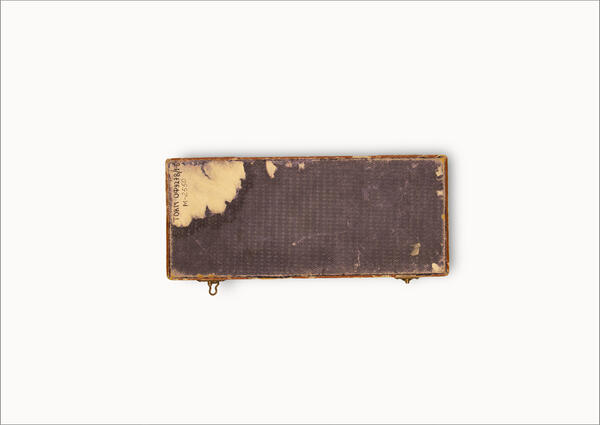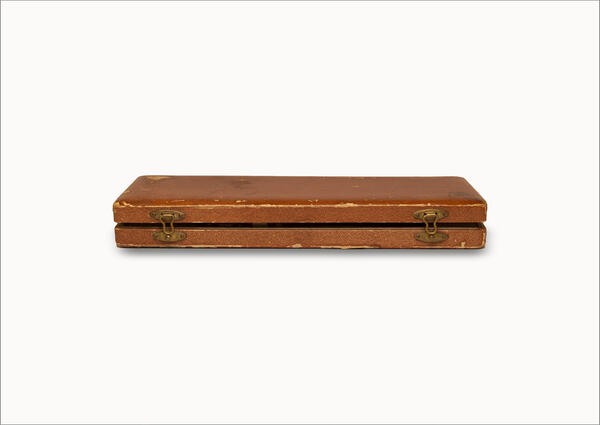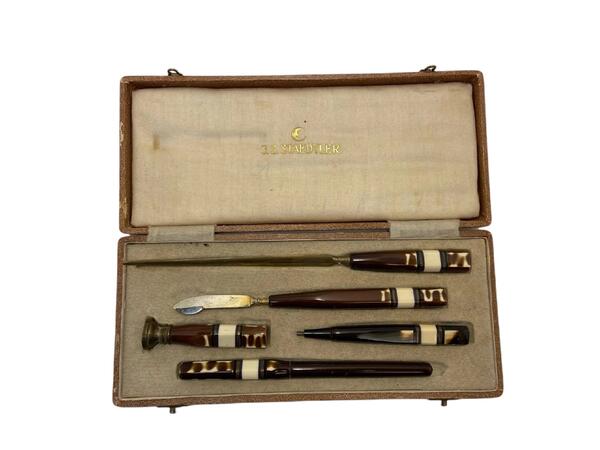
This art deco writing set made by the Bavarian firm J.S. Staedtler consists of a letter opener, a paper knife, a mechanical pencil, a seal (blank, without a coat of arms and initials) and a fountain pen. The handles are made of Bakelite, and the set was most likely produced at the end of the 1930s. Inside the case, there is a logogram of the company and one of its emblems — the moon.
Staedtler is one of the oldest industrial companies and manufacturers of writing instruments in Germany and in the world. It still exists today and is headquartered in Nuremberg. The company was founded on October 3, 1835 by Johann Sebastian Staedtler, the inventor of the colored wood-cased pencil. He was a hereditary craftsman, and his ancestor Friedrich Staedtler was mentioned in the Nuremberg records of 1662 as a “pencil maker”. Johann Sebastian Staedtler himself was able to learn the manual production methods in the workshop of his father Paulus Staedtler, and successfully applied them to mass production.
In the days of the medieval guilds, only 12 Nuremberg artisans had the right to produce pencils, and each of their pencils had a brand mark. When the closest competitor of the Staedtlers, Lothar von Faber, founded a trademark protection society in 1847, the Staedtler company had to register its emblems. The first emblem was a silver crescent, which is present on the case of a writing set from the museum’s collection. The origin of this emblem is obscure. It was registered in 1887, officially certified by the patent authority in Berlin in 1894, and was used until the 1950s.
Taking after the Hardtmuth company, a competitor from Austria-Hungary, the Staedtler designers began searching for new emblems and logos for product lines of various price ranges. They sought to associate their brands with Greco-Roman mythology: the Minerva brand was registered with the Imperial Patent Office in Berlin in 1895, the Mars brand — in 1900. Mars has surpassed the Moon over time.
Staedtler is one of the oldest industrial companies and manufacturers of writing instruments in Germany and in the world. It still exists today and is headquartered in Nuremberg. The company was founded on October 3, 1835 by Johann Sebastian Staedtler, the inventor of the colored wood-cased pencil. He was a hereditary craftsman, and his ancestor Friedrich Staedtler was mentioned in the Nuremberg records of 1662 as a “pencil maker”. Johann Sebastian Staedtler himself was able to learn the manual production methods in the workshop of his father Paulus Staedtler, and successfully applied them to mass production.
In the days of the medieval guilds, only 12 Nuremberg artisans had the right to produce pencils, and each of their pencils had a brand mark. When the closest competitor of the Staedtlers, Lothar von Faber, founded a trademark protection society in 1847, the Staedtler company had to register its emblems. The first emblem was a silver crescent, which is present on the case of a writing set from the museum’s collection. The origin of this emblem is obscure. It was registered in 1887, officially certified by the patent authority in Berlin in 1894, and was used until the 1950s.
Taking after the Hardtmuth company, a competitor from Austria-Hungary, the Staedtler designers began searching for new emblems and logos for product lines of various price ranges. They sought to associate their brands with Greco-Roman mythology: the Minerva brand was registered with the Imperial Patent Office in Berlin in 1895, the Mars brand — in 1900. Mars has surpassed the Moon over time.