From ancient times, the Khakass people were engaged in arts and crafts: they created household objects from wood and birch bark, forged iron and bronze items, decorated clothing with ornaments and applications of leather, inlays, and embroidery. Many interior details and decorations have survived to this day.
Mostly the items were decorated with different patterns. The ornaments always carried a certain symbolism and at the same time helped masters to express their attitude to nature, national culture, and life.
The Turkic peoples considered ornaments as amulets, guardians of human souls, protectors from evil spirits, and symbols of future family prosperity. They also revealed the age and family status of their owners.
One of the most famous Khakass pieces of jewelry was a pogo chest ornament. It is still popular today and is worn on all celebrations.
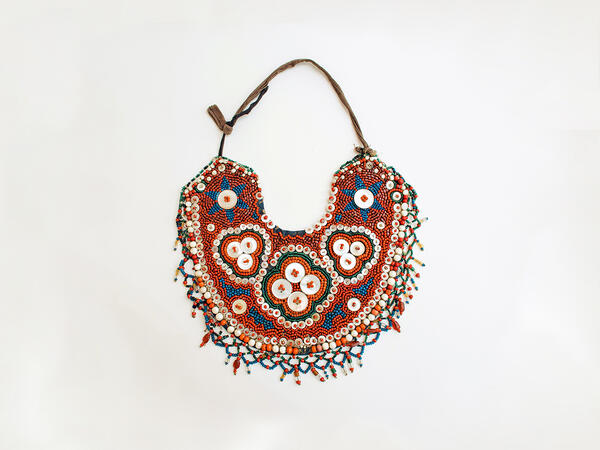
The pogo was originally an obligatory element of a matchmaker’s wedding attire. It was shaped like a crescent with rounded horns. The base for the breastplate was glued from four layers of cotton cloth or made from a piece of tanned leather and then covered with velvet. The front side was decorated with mother-of-pearl buttons. Between them, they sewed coral and beaded patterns in the form of circles, buds, hearts, shamrocks, and other ancient patterns.
The lower edges of the breastplate were trimmed with a fringe of beaded rays — threading — and silver coins were sometimes attached to it. It was believed that the threading symbolized the sun’s rays and bettered a person’s life, while the beads brought wealth to the house.
The pogo had two magical meanings. Firstly, it was considered a strong talisman. In addition, the pogo contributed to the continuation of the family. Therefore, its decoration was thought through: it is a stylized ancient image of the goddess of fertility Umai. The Khakasses believed that this goddess gave souls to children.
According to the Khakass tradition, women embroidered the pogo for their daughters who were getting married. This decoration belonged to the expensive ones: at the beginning of the 19th century, a pogo cost 150 rubles — the same as a felt yurt did.
Today it is customary to give the handmade breastplate to newlyweds at a wedding. It is believed that if there is a pogo, then happiness, prosperity, and success will always be present in the house. Pogos are an important element of national culture. The coat of arms of the Republic of Khakassia features a pogo.
Mostly the items were decorated with different patterns. The ornaments always carried a certain symbolism and at the same time helped masters to express their attitude to nature, national culture, and life.
The Turkic peoples considered ornaments as amulets, guardians of human souls, protectors from evil spirits, and symbols of future family prosperity. They also revealed the age and family status of their owners.
One of the most famous Khakass pieces of jewelry was a pogo chest ornament. It is still popular today and is worn on all celebrations.
The pogo was originally an obligatory element of a matchmaker’s wedding attire. It was shaped like a crescent with rounded horns. The base for the breastplate was glued from four layers of cotton cloth or made from a piece of tanned leather and then covered with velvet. The front side was decorated with mother-of-pearl buttons. Between them, they sewed coral and beaded patterns in the form of circles, buds, hearts, shamrocks, and other ancient patterns.
The lower edges of the breastplate were trimmed with a fringe of beaded rays — threading — and silver coins were sometimes attached to it. It was believed that the threading symbolized the sun’s rays and bettered a person’s life, while the beads brought wealth to the house.
The pogo had two magical meanings. Firstly, it was considered a strong talisman. In addition, the pogo contributed to the continuation of the family. Therefore, its decoration was thought through: it is a stylized ancient image of the goddess of fertility Umai. The Khakasses believed that this goddess gave souls to children.
According to the Khakass tradition, women embroidered the pogo for their daughters who were getting married. This decoration belonged to the expensive ones: at the beginning of the 19th century, a pogo cost 150 rubles — the same as a felt yurt did.
Today it is customary to give the handmade breastplate to newlyweds at a wedding. It is believed that if there is a pogo, then happiness, prosperity, and success will always be present in the house. Pogos are an important element of national culture. The coat of arms of the Republic of Khakassia features a pogo.