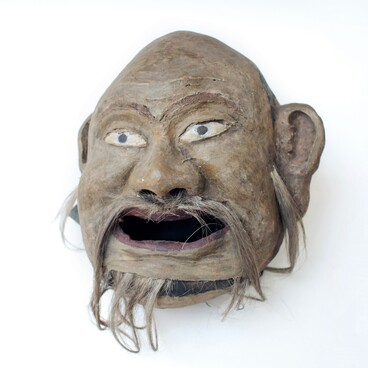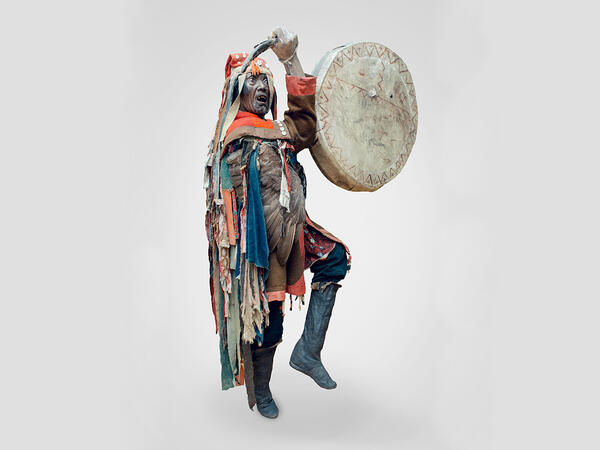
A doll of the shaman was made especially for the World Exhibition in Paris in 1900. It became the central figure of the composition, which recreates the scene of a shamanistic ritual — communication with spirits — over a sick old woman.
Shamanism was widespread among the Khakass until the middle of the 19th century. Future shamans underwent special training in secluded mountain places that were considered sacred. For three whole months, the old, experienced healer became a pastaan paba — a mentor for the young apprentices. At the end of their training, shamans (kams) had to appear before Adam-khan, the mythical head of all the kams. It was believed that Adam-khan endowed each kam with the necessary number of service spirits.
The shaman in the museum’s collection is dressed in the special clothes in which the shamanistic rituals were performed: a jacket, a hat, and boots. The upper garment may have been of two kinds. Straight-cut jackets were made from roe deer hide, and kimono-like jackets were made from black cloth. Long strips of red cloth and bells of various sizes were sewn on top, and the hem was decorated with fringe. A shaman’s jacket symbolizes a bird, so often the wings of a bird of prey or the dried feet of a bird were also attached to it.
Hats were made of red or brown cloth. The front part was decorated with patterns made of cowrie shells and a sparse cloth fringe that covered the face of a shaman, and the bottom edge was edged with a black braid.
Shamans were divided into three categories. Shamans of the highest category — pugdurs — had up to nine tambourines, a special costume, and the largest number of spirits. It was believed that during shamanistic rituals their spirits could reach the Arctic Ocean or even the Mediterranean Sea. Pugdurs prevented epidemics of cattle, led mountain sacrifices, and cured women of infertility. According to beliefs, they received the life force for this — hut — from Umai, the goddess of fertility herself.
Shamans of the middle category were called pulgos. They had only one tambourine, a simple shamanic outfit, and their spirits only reached the neighboring areas of Khakassia. The lowest category — chalanchiks — had the power of hypnosis, treated for the evil eye and fright. They had no costume or tambourine.
The Khakass believed that only shamans had a special soul -mygyra. It is hidden inside an ancestral tree, so there was a tradition of hanging the kam’s garment on it on the fortieth day after his death. It was believed that such a rite saved the spirits that were attached to it: so they could attach themselves to the clothing of another shaman and not perish.
Shamanism was widespread among the Khakass until the middle of the 19th century. Future shamans underwent special training in secluded mountain places that were considered sacred. For three whole months, the old, experienced healer became a pastaan paba — a mentor for the young apprentices. At the end of their training, shamans (kams) had to appear before Adam-khan, the mythical head of all the kams. It was believed that Adam-khan endowed each kam with the necessary number of service spirits.
The shaman in the museum’s collection is dressed in the special clothes in which the shamanistic rituals were performed: a jacket, a hat, and boots. The upper garment may have been of two kinds. Straight-cut jackets were made from roe deer hide, and kimono-like jackets were made from black cloth. Long strips of red cloth and bells of various sizes were sewn on top, and the hem was decorated with fringe. A shaman’s jacket symbolizes a bird, so often the wings of a bird of prey or the dried feet of a bird were also attached to it.
Hats were made of red or brown cloth. The front part was decorated with patterns made of cowrie shells and a sparse cloth fringe that covered the face of a shaman, and the bottom edge was edged with a black braid.
Shamans were divided into three categories. Shamans of the highest category — pugdurs — had up to nine tambourines, a special costume, and the largest number of spirits. It was believed that during shamanistic rituals their spirits could reach the Arctic Ocean or even the Mediterranean Sea. Pugdurs prevented epidemics of cattle, led mountain sacrifices, and cured women of infertility. According to beliefs, they received the life force for this — hut — from Umai, the goddess of fertility herself.
Shamans of the middle category were called pulgos. They had only one tambourine, a simple shamanic outfit, and their spirits only reached the neighboring areas of Khakassia. The lowest category — chalanchiks — had the power of hypnosis, treated for the evil eye and fright. They had no costume or tambourine.
The Khakass believed that only shamans had a special soul -mygyra. It is hidden inside an ancestral tree, so there was a tradition of hanging the kam’s garment on it on the fortieth day after his death. It was believed that such a rite saved the spirits that were attached to it: so they could attach themselves to the clothing of another shaman and not perish.