Karp Andreevich Dokuchaev-Baskov (1849–1916) was born into a peasant family in Kargopol. From his youth, he was interested in the history of his native land, especially its monasteries and hermitages.
In 1873, he received the right to be a folk teacher; the entire following year, with the blessing of the abbot, he devoted to the analysis of the archives of the Kargopol Monastery of the Savior. From 1875 to 1878, he taught at the Zemstvo One-Class School, continuing to work in the church archives of the Olonets Governorate for the 16th–18th centuries.
As a result of these studies, he wrote about 40 works on history of the area, wanderers and ascetics, describing the Chazhenga Old Believer Hermitage, the Kensky Monastery and the Pachomius Pustyn (Hermitage), the Vodlozersk and Blagoveshchenskaya Hermitages, as well as other spiritual centers of Kargopol.
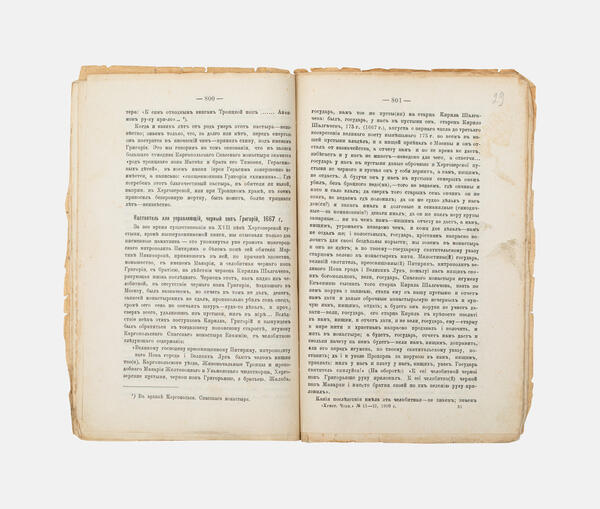
In the presented brochure, Dokuchaev-Baskov chronicles the history of the Dormition Convent, starting with the life of John the Hairy, known as Iona after taking monastic vows. According to the author, in the last quarter of the 16th century, John settled on a hill near Kargopol, where he lived for at least 20 years and where he was buried; the Dormition Church was erected over his grave.
It is believed that the elder founded the monastery. However, according to an earlier hypothesis of Bishop Ambrose Ornatsky, the Dormition Monastery appeared in the 14th century; Dokuchaev-Baskov refuted this version and argued that it was founded in 1578. The same opinion was held by Nikolay Yakovlevich Ozeretskovsky.
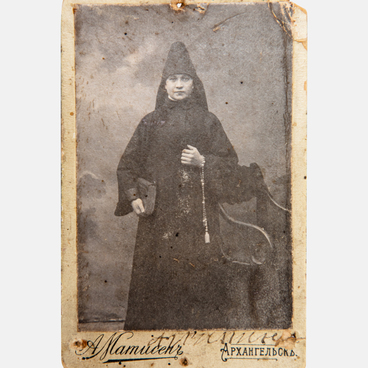
In the early 1650s, the monastery was transformed into a convent by decree of Tsar Alexis I and Metropolitan Nikon of Novgorod.
The main monastery building at the beginning of the 20th century was the stone five-domed Dormition Church built in 1747. The monastery was surrounded by a fence with a gate church in the name of the Venerable Anthony and Theodosius of the Caves (1838).
On the territory of the monastery there was a wooden one-story abbot’s building, a garden, three stone and four wooden fraternal buildings and eight wooden wings for nuns, as well as the necessary amenities: barns, cellars, carriage houses, a dairy house, baths, laundry, and icehouses. Behind the fence there was a hotel for pilgrims, a stable, a couple of carriage houses, a bathhouse, a threshing floor, and a monastery cemetery. The monastery owned land near Chelma Hill for fishing, forest cottages, several estates with buildings and a mill where the monks made flour.
In 1892, Dokuchaev’s work “Ascetics and Monasteries
of the Far North” was nominated for the Uvarov Prize of the Academy of
Sciences.