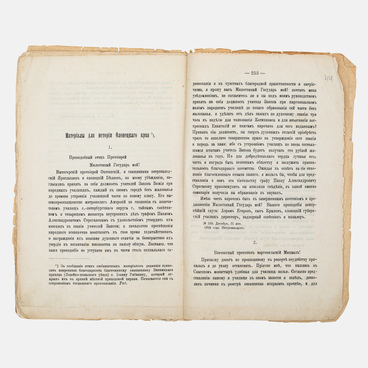
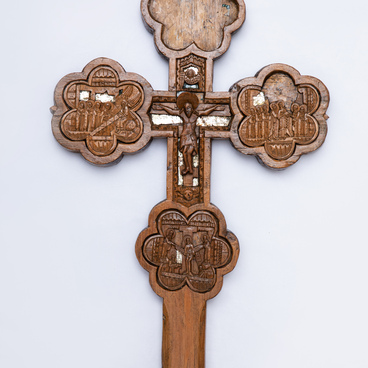
In the second half of the 16th century, presumably in 1578, a monastery appeared in Kargopol, named after John the Hairy (John the Merciful of Rostov) in honor of the founder the Elder John, as well as a nearby spring. By 1649, by the decree of Metropolitan Nikon of Novgorod, the monastery, which had fallen into disrepair, was abolished. In its place, the Dormition Convent was established.
The photo depicts Agrippina Semyonovna Kurina, who was destined for monastic service from birth. Her parents, residents of Kargopol, remained childless for a long time and begged for a child. Once on business in Solovki, Semyon Kurin vowed that his firstborn, if it appeared, would devote their life to God. Soon after, two daughters were born in the family: the elder Agrippina and the younger Irina. When Agrippina was seven years old, her parents sent her to the Dormition Convent. The girl studied at a parochial school and lived in a night shelter at the convent. There, one of the wooden buildings housed the school and the teacher’s apartment.
The pupils were given a basic education, and in addition, they were taught housekeeping and crafts; according to the memoirs of contemporaries, many nuns were skilled herbalists. In 1914, Agrippina began to prepare for the taking of the veil. According to the rules that were in force in the Russian Empire, the novitiate lasted at least six years. During that time, novices did not yet take monastic vows, they were allowed to wear a cassock instead of a cowl (the latter had wide sleeves). They performed various duties and got used to monastic life.
After the events of 1917, Abbess Varvara and 30 sisters remained in the convent; in 1924, an agricultural labor artel was organized there. In 1929 — and according to the memoirs of some nuns, by the summer of 1925 — it was “offered” to the nuns to look for another place of residence. By that time Agrippina was already a nun.
Agrippina Kurina (Grunya, Grusha, as her neighbors called her) moved to her house on the corner of Bolotnikova and Sovetskaya, continued to lead a monastic lifestyle and engaged in crafts: sewing, knitting, and embroidery. Residents of Kargopol remembered her as a “kind nun” and a “spiritually strong person.” It was said that she was able to relieve pain and alleviate the spiritual suffering of the dying.
The story of Agrippina Semyonovna Kurina, as well
as other sisters of the Dormition Convent, became largely known thanks to the
research of Yury Ivanovich Kimaev.