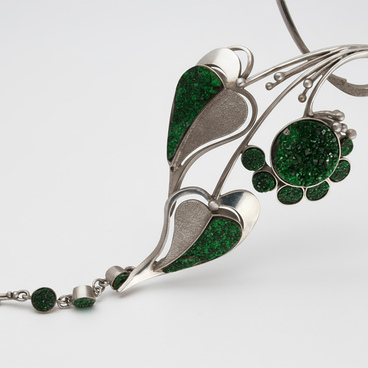
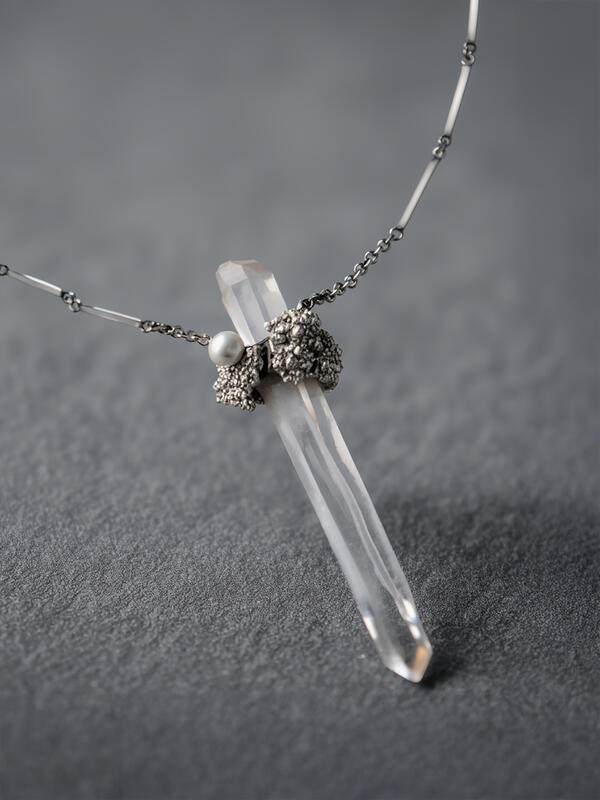
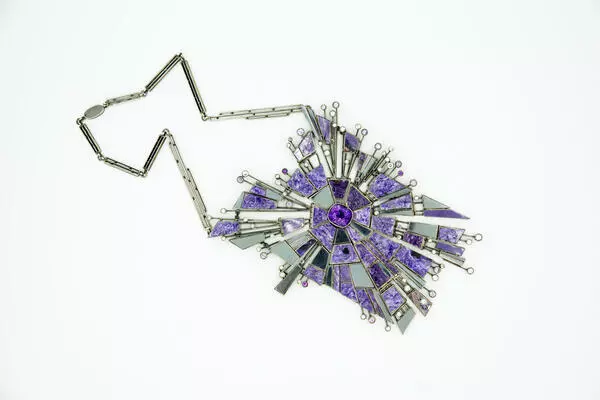
Vladislav Mikhailovich Khramtsov was a leading figure in Ural jewelry art. His primary focus was women’s jewelry. Through his vision and craftsmanship, he played a key role in elevating the artistic quality of the Sverdlovsk Jewelry Factory’s products. After leaving the factory, Khramtsov shifted his focus to individual commissions, but his creative potential found its fullest expression in exhibition and museum works — pieces conceived not for wear, but for contemplation.
Due to their monumentality and complex composition, Khramtsov’s creations transcend traditional jewelry, evolving into jewelry installations and sculptural objects. His style is marked by incredible diversity: from classical lapidary techniques to bold experiments in contemporary art, where paradoxical material combinations and open, high-tech structures coexist in dynamic harmony.
As a true representative of the Ural jewelry school, Khramtsov believed that the beauty of the stone is self-sufficient. For him, the gemstone was not merely an ornament, but the organizing center and aesthetic dominant of the composition. This philosophy guided his meticulous approach — honoring the natural character of the stone and striving to reveal its inherent beauty to the fullest.
Throughout his career, Khramtsov explored a wide range of themes: natural motifs, cosmic imagery, fantasy and fairy-tale narratives, and stories drawn from Ural legends and folklore. A striking example is the pendant “Ural Maiden” — a poetic tribute to the region and its mineral heritage. The composition features a metal chain set with oval malachite cabochons, from which hangs a two-part pendant of wavy malachite plates mounted in a smooth setting. The plates form a downward-pointing acute angle, accentuated by a central circular cabochon. Attached to it is a movable element: a metal plate adorned with three looped forms made of twisted wire and decorative spheres.
The choice of malachite is deeply symbolic. It is renowned for its rich green hues and mesmerizing patterns, resembling concentric rings of varying diameters.
In Russia, large deposits of malachite were discovered in the Urals in the 18th century, during the development of copper mines. Initially, malachite was used primarily for inlays in brooches, rings, and earrings. Its true fame came in the 19th century, when it gained prominence not only as a decorative stone, but also as a material for luxurious interior design, gracing the halls of imperial palaces. Over time, malachite became inextricably linked with the Urals. With the publication of Pavel Bazhov’s tales, in which the stone often appears as a magical, living entity, malachite entered the national consciousness as a powerful symbol of the region’s natural and cultural identity.