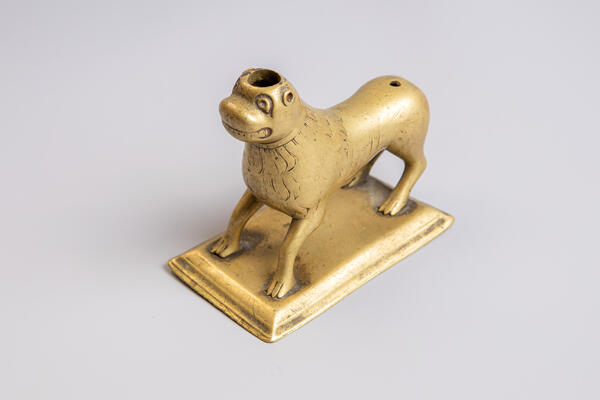
This exhibit is one of several parts of an extremely rare zoomorphic candlestick. It is called a “stoyan” and is the massive base of a tabletop candelabra. The object of the 17th century was cast in bronze.
A series of similar candlesticks has been preserved in the collection of the State Historical Museum. The work, which is on display in the Museum “The Smolensk Fortress” can be attributed to the same workshop that produced the items from the Moscow collection.
In the 17th century, lighting interiors was a difficult task. Candles, torches, and oil lamps were extremely flammable. Therefore, the development of candlesticks that did not allow the fire to spread was especially important for this era. The candlestick had to be massive so that the flame of the candle did not fall on combustible surfaces, and sufficiently stable.
Artisans chose non-combustible materials for such products, metal and various alloys — tin, brass, bronze and silver ones. In addition, the shape of the candlestick and its details had to be clearly visible when the candle was burning. Beautiful candlesticks were a credit to their owner, testifying to his taste and wealth.
The massive standing candlestick of the 17th century fully met these requirements. The craftsman who made this piece knew his job and was no doubt a full-time candelabra maker.
The artisan paid attention to the detailed study of this work of arts and crafts. The master accentuated the features of the muzzle, mane, and paws. The curved tail was a separate detail of the figure. The lion was presented in an expressive pose. The beast seems to be preparing for a jump, an attack. Such dynamics was characteristic of the Baroque era, to which this product belongs.
For strength, usefulness and beauty, the figure of a lion was placed on a beveled pedestal. The golden color of the metal surface harmoniously combined with the bright hues typical of the richly decorated interior of the 17th century. The image of a lion was one of the most common heraldic motifs.
A series of similar candlesticks has been preserved in the collection of the State Historical Museum. The work, which is on display in the Museum “The Smolensk Fortress” can be attributed to the same workshop that produced the items from the Moscow collection.
In the 17th century, lighting interiors was a difficult task. Candles, torches, and oil lamps were extremely flammable. Therefore, the development of candlesticks that did not allow the fire to spread was especially important for this era. The candlestick had to be massive so that the flame of the candle did not fall on combustible surfaces, and sufficiently stable.
Artisans chose non-combustible materials for such products, metal and various alloys — tin, brass, bronze and silver ones. In addition, the shape of the candlestick and its details had to be clearly visible when the candle was burning. Beautiful candlesticks were a credit to their owner, testifying to his taste and wealth.
The massive standing candlestick of the 17th century fully met these requirements. The craftsman who made this piece knew his job and was no doubt a full-time candelabra maker.
The artisan paid attention to the detailed study of this work of arts and crafts. The master accentuated the features of the muzzle, mane, and paws. The curved tail was a separate detail of the figure. The lion was presented in an expressive pose. The beast seems to be preparing for a jump, an attack. Such dynamics was characteristic of the Baroque era, to which this product belongs.
For strength, usefulness and beauty, the figure of a lion was placed on a beveled pedestal. The golden color of the metal surface harmoniously combined with the bright hues typical of the richly decorated interior of the 17th century. The image of a lion was one of the most common heraldic motifs.