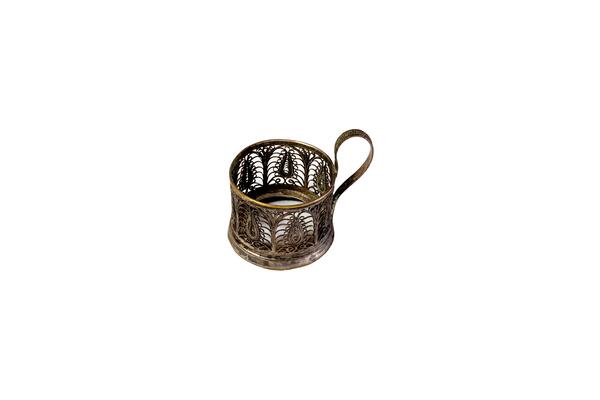
A glass holder is a cylindrical holder for a tea glass. It covered the bottom part of the glass and had a handle that protected fingers from burns. In addition, a metal glass holder drew off heat from the glass. It protected a glass from cracking.
It is believed that the first glass holders similar to modern ones, appeared in Russia in the 18th century. At that time, according to basic table manners, women were supposed to drink tea from porcelain cups, and men were supposed to drink tea from glasses in metal glass holders.
Glass holders were first manufactured in Kolchugino, the Vladimir Governorate in the 19th century. There was a metallurgical plant with a pressing workshop, where utensils including samovars, teapots, pots, and other kitchenware were produced. Since 1892, glass holders became obligatory train attributes in the Russian Empire. Minister of Railways, Sergei Witte, incorporated glass holders by a special decree because train attendants often complained about injuries caused by hot tea glasses. It was too inconvenient to serve hot tea while a train was moving. Boiling water used to spill on hands, and even on passengers. It could turn into a serious scandal. Since that time and to the present day, glass holders are widely used in trains. Nowadays, they can be bought as souvenirs.
A metal glass holder from the collection of Nizhnevartovsk Museum of Local History was made in the Soviet period between 1965 and 1975. It was produced by the Kazakovo Plant of Art Objects, which worked in the Gorky (now Nizhny Novgorod) Region. There is a brand mark in the lower part of a glass holder. The bottom is made in a form of a small metal rim that supported a glass from below.
A glass holder was made in the filigree technique. Its sides look like lace, but they are made of thin metal wire soldered to a base and a top rim. The pattern consists of seven identical openwork arches with decorative elements in the form of a large drop in the center of each of them. A high curved handle is soldered to top and bottom rims. It is also decorated with small notches.
It is believed that the first glass holders similar to modern ones, appeared in Russia in the 18th century. At that time, according to basic table manners, women were supposed to drink tea from porcelain cups, and men were supposed to drink tea from glasses in metal glass holders.
Glass holders were first manufactured in Kolchugino, the Vladimir Governorate in the 19th century. There was a metallurgical plant with a pressing workshop, where utensils including samovars, teapots, pots, and other kitchenware were produced. Since 1892, glass holders became obligatory train attributes in the Russian Empire. Minister of Railways, Sergei Witte, incorporated glass holders by a special decree because train attendants often complained about injuries caused by hot tea glasses. It was too inconvenient to serve hot tea while a train was moving. Boiling water used to spill on hands, and even on passengers. It could turn into a serious scandal. Since that time and to the present day, glass holders are widely used in trains. Nowadays, they can be bought as souvenirs.
A metal glass holder from the collection of Nizhnevartovsk Museum of Local History was made in the Soviet period between 1965 and 1975. It was produced by the Kazakovo Plant of Art Objects, which worked in the Gorky (now Nizhny Novgorod) Region. There is a brand mark in the lower part of a glass holder. The bottom is made in a form of a small metal rim that supported a glass from below.
A glass holder was made in the filigree technique. Its sides look like lace, but they are made of thin metal wire soldered to a base and a top rim. The pattern consists of seven identical openwork arches with decorative elements in the form of a large drop in the center of each of them. A high curved handle is soldered to top and bottom rims. It is also decorated with small notches.