A plow is an agricultural tool used to break the soil and turn its top layer over. That process made the ground softer and more pliable, saturated with air. It also helped to reduce the number of weed plants.
Plows were even used in Babylon and Ancient Egypt. In those days, they were made of wood. At first, peasants had to pull plows in the fields themselves. Later, they started to harness oxen, mules, and horses. Similar tools appeared among the Slavic tribes around the 8th or 9th century AD.
If the soil was soft and clean, it was enough to harness only one horse. If the soil was heavy, dense, and rocky, two horses were needed: one horse was led along a furrow, and another one was led nearby along an uncultivated strip. This work was very hard and the peasants gave horses a rest every half an hour. They did not want to overwork the horses.
The first metal horse plows appeared in Russia at the end of the 18th century. At first, they were handmade. In 1802, they were produced at plants for the first time. Gradually, iron was replaced by stronger and lighter steel. The working part of such plows was called a plowshare. It was a steel plate with a sharp blade, which plowed soil. Virgin soil and topsoil were cultivated by a toothed plowshare. Another tool with retractable chisels was chosen for clay soils. The blades became dull and deformed pretty quickly. So, they had to be sharpened and straightened regularly.
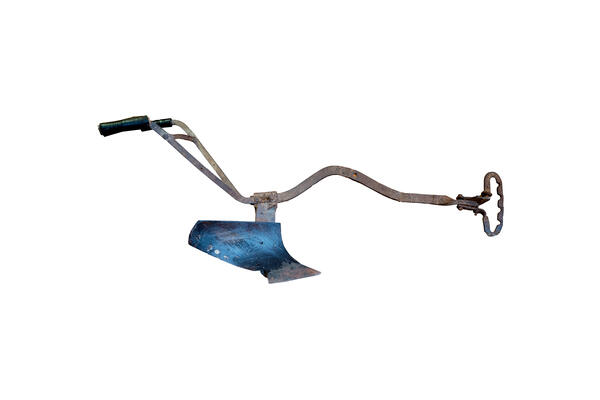
A horse plow from the collection of Nizhnevartovsk Museum of Local History was made in the 1930s. Its plowshare has a trapezoidal form. As a rule, such tools were used to plow soft soil that had been cultivated before.
The handle of a plow was made of two connected metal rods. It is attached to a body with two screws. There are rubber tarpaulin pads on each handle. The worker’s hands could slip in the process; so, the coverings helped to avoid such a situation.
Motorized plows started to be produced only after the Bolshevik Revolution. They were attached to tractors. The first series of such tools appeared in 1925.
Plows were even used in Babylon and Ancient Egypt. In those days, they were made of wood. At first, peasants had to pull plows in the fields themselves. Later, they started to harness oxen, mules, and horses. Similar tools appeared among the Slavic tribes around the 8th or 9th century AD.
If the soil was soft and clean, it was enough to harness only one horse. If the soil was heavy, dense, and rocky, two horses were needed: one horse was led along a furrow, and another one was led nearby along an uncultivated strip. This work was very hard and the peasants gave horses a rest every half an hour. They did not want to overwork the horses.
The first metal horse plows appeared in Russia at the end of the 18th century. At first, they were handmade. In 1802, they were produced at plants for the first time. Gradually, iron was replaced by stronger and lighter steel. The working part of such plows was called a plowshare. It was a steel plate with a sharp blade, which plowed soil. Virgin soil and topsoil were cultivated by a toothed plowshare. Another tool with retractable chisels was chosen for clay soils. The blades became dull and deformed pretty quickly. So, they had to be sharpened and straightened regularly.
A horse plow from the collection of Nizhnevartovsk Museum of Local History was made in the 1930s. Its plowshare has a trapezoidal form. As a rule, such tools were used to plow soft soil that had been cultivated before.
The handle of a plow was made of two connected metal rods. It is attached to a body with two screws. There are rubber tarpaulin pads on each handle. The worker’s hands could slip in the process; so, the coverings helped to avoid such a situation.
Motorized plows started to be produced only after the Bolshevik Revolution. They were attached to tractors. The first series of such tools appeared in 1925.