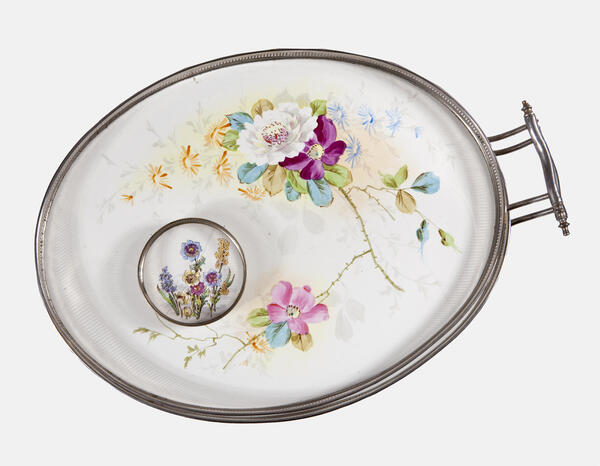
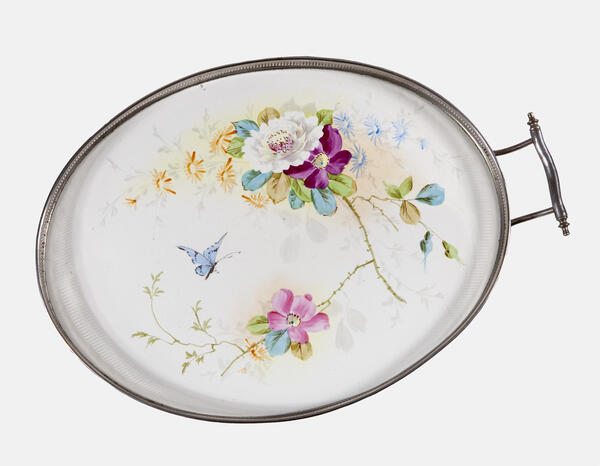
The oval tray with two handles and the round stand are made of faience and encased in silver-plated metal. Such tableware was extremely popular at the turn of the 20th century.
Judging by the red stamp with the image of a tree and the letters M and D on the reverse side of the stand, it was produced in the German city of Nuremberg, at the well-known metalware and ceramics factory of Max Dannhorn. The oval tray is likely to have also been produced at the same factory.
The products of the Dannhorn factory were designed in a uniform style. Light-colored porcelain and faience inserts were decorated with inscriptions, landscapes, and images of animals, birds, insects, and flowers. The items from the museum’s collection provide an example of such décor.
The Dannhorn factory usually ordered ceramic inserts from the renowned Villeroy and Boch — a company that was founded back in 1836. At the turn of the 20th century, innovative technologies for transferring images onto products appeared, such as machine printing and decal. These techniques made it possible to eliminate manual processes and, accordingly, reduce the cost of manufacturing. As a result, products became affordable to all customers. They were also exported to other European countries and the Russian Empire.
The faience, which was used by Villeroy & Boch to make the ceramic inserts for the tray and stand, is quite similar to porcelain in composition and appearance. However, it still has certain specific qualities.
Faience is an opaque material. It is less durable than porcelain. Over time, a pattern of cracks may appear on the surface even due to shifts in temperature. The advantages of faience include its lower cost compared to porcelain and, therefore, its affordability.
The stand features hyacinths and daffodils depicted with botanical precision. The color palette is distinguished by the tender pastel shades of blue, pink, green, and yellow. The oval tray is painted with images of roses, rose hips, and daisies, as well as a butterfly that flutters between them. These images are less precise. However, they are also characterized by the accurate reproduction of the tiniest details. The design of the products is complemented by the openwork borders made of silver-plated metal.
Judging by the red stamp with the image of a tree and the letters M and D on the reverse side of the stand, it was produced in the German city of Nuremberg, at the well-known metalware and ceramics factory of Max Dannhorn. The oval tray is likely to have also been produced at the same factory.
The products of the Dannhorn factory were designed in a uniform style. Light-colored porcelain and faience inserts were decorated with inscriptions, landscapes, and images of animals, birds, insects, and flowers. The items from the museum’s collection provide an example of such décor.
The Dannhorn factory usually ordered ceramic inserts from the renowned Villeroy and Boch — a company that was founded back in 1836. At the turn of the 20th century, innovative technologies for transferring images onto products appeared, such as machine printing and decal. These techniques made it possible to eliminate manual processes and, accordingly, reduce the cost of manufacturing. As a result, products became affordable to all customers. They were also exported to other European countries and the Russian Empire.
The faience, which was used by Villeroy & Boch to make the ceramic inserts for the tray and stand, is quite similar to porcelain in composition and appearance. However, it still has certain specific qualities.
Faience is an opaque material. It is less durable than porcelain. Over time, a pattern of cracks may appear on the surface even due to shifts in temperature. The advantages of faience include its lower cost compared to porcelain and, therefore, its affordability.
The stand features hyacinths and daffodils depicted with botanical precision. The color palette is distinguished by the tender pastel shades of blue, pink, green, and yellow. The oval tray is painted with images of roses, rose hips, and daisies, as well as a butterfly that flutters between them. These images are less precise. However, they are also characterized by the accurate reproduction of the tiniest details. The design of the products is complemented by the openwork borders made of silver-plated metal.