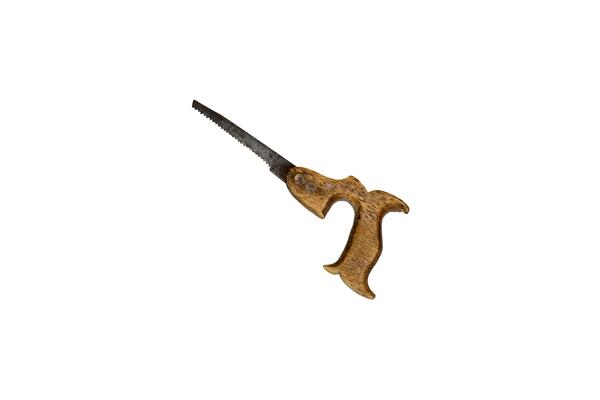
A hand saw from the exhibition of Nizhnevartovsk Museum of Local History was used for woodworking. It looks like a modern narrow pad saw and consists of a metal sheet with sharpened teeth and a wooden handle that is fixed by two rivets. Such a tool was used for delicate work. For example, for sawing different through holes and complex figured details. Its narrow blade helped to change the cutting direction without any problems.
The teeth of a saw are shaped in the form of isosceles triangles. Their size, as well as the location of the cutting edges, depended on the specific purpose of a tool. For example, it depended on the direction of sawing (along or across fibers of the wood). It was necessary to sharpen the teeth from time to time. Otherwise, they started to tear fibers or could not cut wood at all.
The first tools, which looked like saws, appeared about four thousand years ago. Back then, they looked like sharpened stones, which were found ready-made or specially prepared in this way. Such teeth could be used in a working process with relatively soft materials that are bones, wood, and some kinds of stone. They were used to carve ritual images.
In ancient Rome and Egypt, the saws were made of copper. Even though people considered this metal soft, the instruments, which were made of it, could even cut through hard stones. However, it was necessary to add abrasive material under the teeth of the saw in order to do so.
Until the beginning of the 1st millennium BC, all saws were one-handed. Then, the first two-handed models appeared in Phenicia. Two masters could simultaneously use them. People even sawed logs into beams using them.
The first iron saws appeared in Scandinavia. They probably came to Russia from there. At first, they were cast in stone molds. Unfortunately, this method did not allow obtaining solid durable items. Later, the masters started to forge the saws. However, such tools were not especially popular and were mainly used by professional carpenters. The saw was needed for complex and delicate woodworking. Simple actions were usually performed with an ax that was also used to cut forest trees and collect firewood.
The teeth of a saw are shaped in the form of isosceles triangles. Their size, as well as the location of the cutting edges, depended on the specific purpose of a tool. For example, it depended on the direction of sawing (along or across fibers of the wood). It was necessary to sharpen the teeth from time to time. Otherwise, they started to tear fibers or could not cut wood at all.
The first tools, which looked like saws, appeared about four thousand years ago. Back then, they looked like sharpened stones, which were found ready-made or specially prepared in this way. Such teeth could be used in a working process with relatively soft materials that are bones, wood, and some kinds of stone. They were used to carve ritual images.
In ancient Rome and Egypt, the saws were made of copper. Even though people considered this metal soft, the instruments, which were made of it, could even cut through hard stones. However, it was necessary to add abrasive material under the teeth of the saw in order to do so.
Until the beginning of the 1st millennium BC, all saws were one-handed. Then, the first two-handed models appeared in Phenicia. Two masters could simultaneously use them. People even sawed logs into beams using them.
The first iron saws appeared in Scandinavia. They probably came to Russia from there. At first, they were cast in stone molds. Unfortunately, this method did not allow obtaining solid durable items. Later, the masters started to forge the saws. However, such tools were not especially popular and were mainly used by professional carpenters. The saw was needed for complex and delicate woodworking. Simple actions were usually performed with an ax that was also used to cut forest trees and collect firewood.