It is a tradition of very long standing that women should cover their heads with a scarf. Head covering was based on sharia laws (laws of God). The Tatar women’s national costume included an obligatory shawl to cover the head, hair and shoulders.
By the late 19th century, a number of shawls —“berkanchek”, “tugerek yaulyk”, “orpek”, and “tastar” — had stopped being widely popular. These original headdresses came in different shapes (square, triangular, and towel-shaped), decorative elements (embroidery, appliqué, and patterned weaving) and methods of wearing. They were replaced by factory-made headscarves and shawls. At that time, they became universal headdresses for almost the entire female population of our country, being both an adornment and a necessity for a Muslim woman.
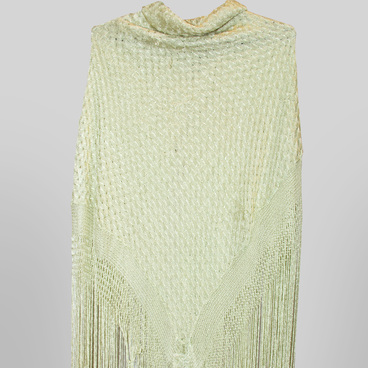
Openwork silk shawls were put on when leaving the house: elderly wealthy women wore them under a fur hat “kamchat burek”, and young women and girls wrapped them on top of a kalfak. Shawls with long tassels did not cover only the head — they reached the shoulders and the tassels (18–20 cm long) created the impression of a braid. Scarves with certain patterns have their own purpose and differ not only in function, but also in ranks. The way they look (namely, their patterns) tell a lot about the woman’s status.
The Tatar costume tells about the individual features of a person, his or her character and aesthetic tastes. Clothes is a way to find out about the wearer’s age and social status. The Tatar costume is the most striking indicator of a person’s national identity. A headdress was considered an obligatory element of the traditional Tatar costume. The girls wore a multi-layered “construction” on their heads, consisting of the following elements: fabric, veil, hoop, hat or scarf. With the help of the latter, the veil was fixed on the head.
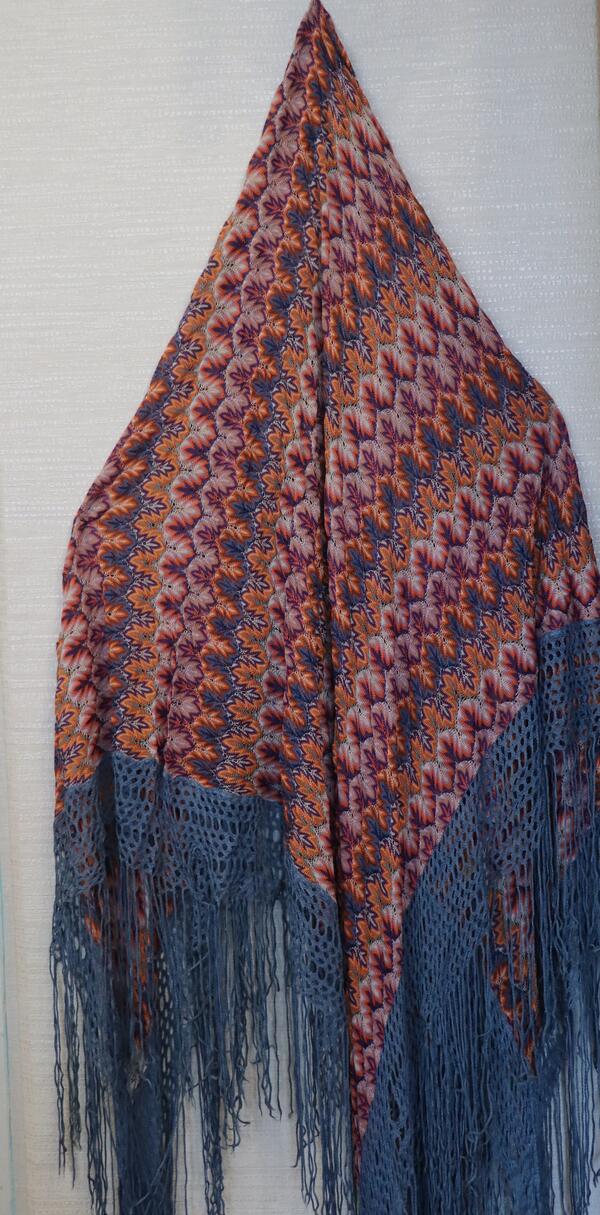
The shawl was donated to the museum in 1999 by Fatima Yaminova, an old resident of the village of Turaeva. The entire rectangular colored scarf is covered with a geometric pattern, and the edges are trimmed with a knitted blue fringe.
By the late 19th century, a number of shawls —“berkanchek”, “tugerek yaulyk”, “orpek”, and “tastar” — had stopped being widely popular. These original headdresses came in different shapes (square, triangular, and towel-shaped), decorative elements (embroidery, appliqué, and patterned weaving) and methods of wearing. They were replaced by factory-made headscarves and shawls. At that time, they became universal headdresses for almost the entire female population of our country, being both an adornment and a necessity for a Muslim woman.
Openwork silk shawls were put on when leaving the house: elderly wealthy women wore them under a fur hat “kamchat burek”, and young women and girls wrapped them on top of a kalfak. Shawls with long tassels did not cover only the head — they reached the shoulders and the tassels (18–20 cm long) created the impression of a braid. Scarves with certain patterns have their own purpose and differ not only in function, but also in ranks. The way they look (namely, their patterns) tell a lot about the woman’s status.
The Tatar costume tells about the individual features of a person, his or her character and aesthetic tastes. Clothes is a way to find out about the wearer’s age and social status. The Tatar costume is the most striking indicator of a person’s national identity. A headdress was considered an obligatory element of the traditional Tatar costume. The girls wore a multi-layered “construction” on their heads, consisting of the following elements: fabric, veil, hoop, hat or scarf. With the help of the latter, the veil was fixed on the head.
The shawl was donated to the museum in 1999 by Fatima Yaminova, an old resident of the village of Turaeva. The entire rectangular colored scarf is covered with a geometric pattern, and the edges are trimmed with a knitted blue fringe.