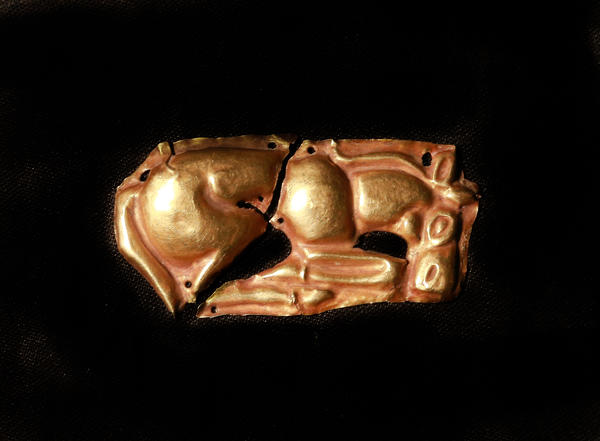
The plate portraying an Asiatic wild ass was found in the course of research activities near the KomsomOlsky village of the KrasnoYArsky District in the Astrakhan Region in 1987. This decoration - a gold sewn-on appliqué - was found on a woman’s chest. The head of the buried woman was adorned with a felt headdress (kalAf) with gold plates.
The plate with a wild ass is embossed. Embossing is a method of making repoussé images on metal plates.
An asiatic wild ass (kulan) is a hoofed animal from the equine family. His exterior resembles a donkey or a horse. Traditionally, ungulates were depicted standing or jumping, but our case is a clear deviation from the canon. At the same time, an ancient craftsman performed neat work: the bent limbs of the animal preserved their grace. The head and tail of the kulan are bent down.
Scientists have found out that the jewelry was made in the 6th-5th centuries BC, in the era of the SavromAts. The SavromAts (VII-IV centuries BC) were the first representatives of the common Sarmatian nomadic culture, which dominated the Eastern Europe for a thousand years. The area of the Savromat culture covers the Don, Volga and Ural steppes. The SavromAts led a nomadic lifestyle and were in constant motion. Men moved mainly on horseback, their households - women, children, old people - rode in carts pulled by bulls. Their carts were a kind of wheeled houses. They were covered with felt and leather. In addition to carts, people also had other dwellings that resembled yurts. However, sometimes they lived in a kind of not deep semi-dugouts in those places where they traditionally spent winter time: near the floodplain of the Volga River and near fresh lakes in the steppe. However, archaeologists have encountered very few such dwellings.
The main occupation of the Savromat tribes was nomadic cattle breeding. They left almost no structures behind, and scientists study the culture of the SavromAts mainly from burials, during archaeological excavations.
In 2005, the zoomorphic plate portraying an Asiatic wild ass and other archelogical finds were exhibited at the Astrakhan Steppe Treasures show at the National Museum of the Palazzo Venezia in Rome.
The plate with a wild ass is embossed. Embossing is a method of making repoussé images on metal plates.
An asiatic wild ass (kulan) is a hoofed animal from the equine family. His exterior resembles a donkey or a horse. Traditionally, ungulates were depicted standing or jumping, but our case is a clear deviation from the canon. At the same time, an ancient craftsman performed neat work: the bent limbs of the animal preserved their grace. The head and tail of the kulan are bent down.
Scientists have found out that the jewelry was made in the 6th-5th centuries BC, in the era of the SavromAts. The SavromAts (VII-IV centuries BC) were the first representatives of the common Sarmatian nomadic culture, which dominated the Eastern Europe for a thousand years. The area of the Savromat culture covers the Don, Volga and Ural steppes. The SavromAts led a nomadic lifestyle and were in constant motion. Men moved mainly on horseback, their households - women, children, old people - rode in carts pulled by bulls. Their carts were a kind of wheeled houses. They were covered with felt and leather. In addition to carts, people also had other dwellings that resembled yurts. However, sometimes they lived in a kind of not deep semi-dugouts in those places where they traditionally spent winter time: near the floodplain of the Volga River and near fresh lakes in the steppe. However, archaeologists have encountered very few such dwellings.
The main occupation of the Savromat tribes was nomadic cattle breeding. They left almost no structures behind, and scientists study the culture of the SavromAts mainly from burials, during archaeological excavations.
In 2005, the zoomorphic plate portraying an Asiatic wild ass and other archelogical finds were exhibited at the Astrakhan Steppe Treasures show at the National Museum of the Palazzo Venezia in Rome.