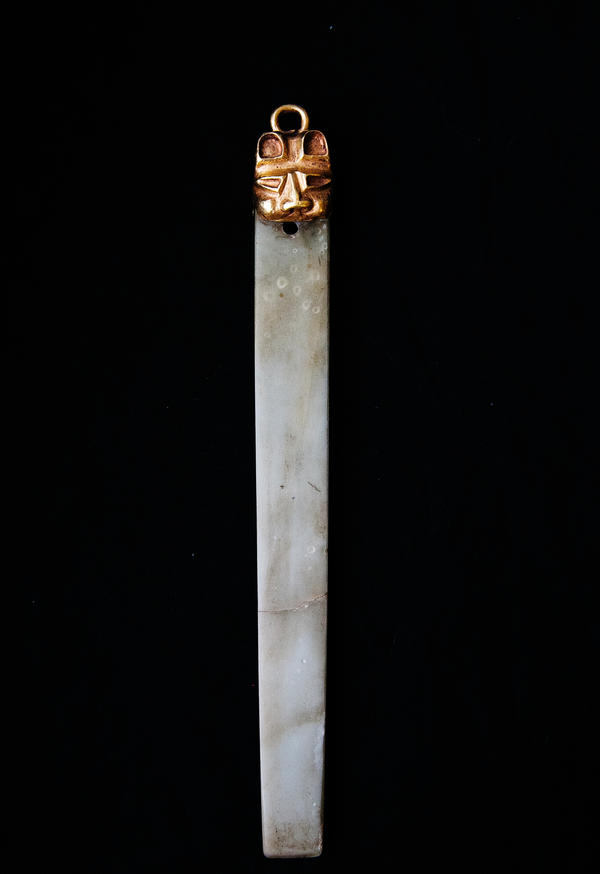
Rectangular sharpening stone made of gray-white stone with a removable lion head
A sharpening stone is a whetstone in the form of a bar. Since ancient times, they have been used to sharpen the blades of knives, scythes and other cutting objects. The rectangular sharpening stone from the Astrakhan Museum Reserve collection was found in the BEra burial mound near the KOsika village in the YenotAyevsky District. This burial was opened and destroyed in 1984, when a water culvert trench was laid there.
The sharpening stone is made of gray-white nephrite and decorated with a removable lion head. Zoomorphic images were very popular in the Scythian-Sarmatian culture: at that time it was believed that each of them personifies certain qualities and patronizes people. The images of rams, horses, birds and feline predators were especially popular in the art of the nomads of the Scythian-Sarmatian era.
Usually, ancient craftsmen depicted animals of various types. In our case, it is not clear what species of cats the animal belongs to. Scientists call such images with similar details as ‘Sarmatian panthers’: rounded outlines with a blunt muzzle, as if cut off at a right angle, a prominent, wide, large nose pressed between convex cheeks, round eyes and semi-oval ears. A sharpening stone of this kind most likely served as a worship item. It can be seen that the cat is depicted as non-aggressive; the toothy mouth is not even shown.
Nephrite (originated from ancient Greek word for kidney; its obsolete name was kidney stone) is a mineral featured with fibrous structure. One of its most valuable properties is its extremely high impact strength. Nephrite is difficult to split; since ancient times, it was valued for its hardness and durability. It personified wisdom and eternity, Heaven and Earth. Nephrite jewelry had deep meanings and was considered talismans. Besides nephrite, jewelry and worship items were decorated with inserts of precious and semi-precious stones, as well as of coloured glass and glass paste.
In 2005, the sharpening stone and other valuable ancient items from the Astrakhan Museum Reserve collection were exhibited at the Astrakhan Steppe Treasures show at the National Museum of the Palazzo Venezia in Rome.
A sharpening stone is a whetstone in the form of a bar. Since ancient times, they have been used to sharpen the blades of knives, scythes and other cutting objects. The rectangular sharpening stone from the Astrakhan Museum Reserve collection was found in the BEra burial mound near the KOsika village in the YenotAyevsky District. This burial was opened and destroyed in 1984, when a water culvert trench was laid there.
The sharpening stone is made of gray-white nephrite and decorated with a removable lion head. Zoomorphic images were very popular in the Scythian-Sarmatian culture: at that time it was believed that each of them personifies certain qualities and patronizes people. The images of rams, horses, birds and feline predators were especially popular in the art of the nomads of the Scythian-Sarmatian era.
Usually, ancient craftsmen depicted animals of various types. In our case, it is not clear what species of cats the animal belongs to. Scientists call such images with similar details as ‘Sarmatian panthers’: rounded outlines with a blunt muzzle, as if cut off at a right angle, a prominent, wide, large nose pressed between convex cheeks, round eyes and semi-oval ears. A sharpening stone of this kind most likely served as a worship item. It can be seen that the cat is depicted as non-aggressive; the toothy mouth is not even shown.
Nephrite (originated from ancient Greek word for kidney; its obsolete name was kidney stone) is a mineral featured with fibrous structure. One of its most valuable properties is its extremely high impact strength. Nephrite is difficult to split; since ancient times, it was valued for its hardness and durability. It personified wisdom and eternity, Heaven and Earth. Nephrite jewelry had deep meanings and was considered talismans. Besides nephrite, jewelry and worship items were decorated with inserts of precious and semi-precious stones, as well as of coloured glass and glass paste.
In 2005, the sharpening stone and other valuable ancient items from the Astrakhan Museum Reserve collection were exhibited at the Astrakhan Steppe Treasures show at the National Museum of the Palazzo Venezia in Rome.