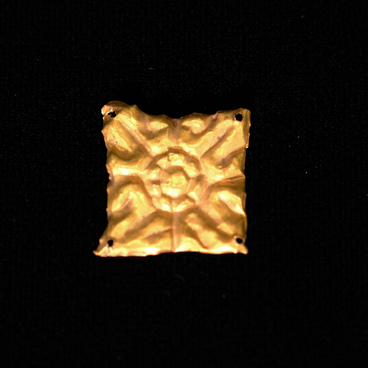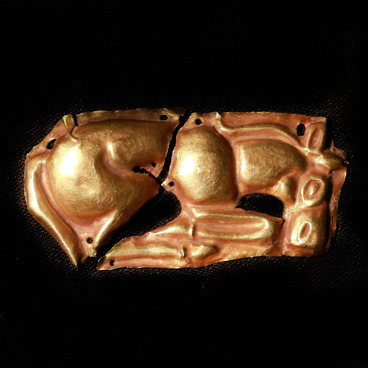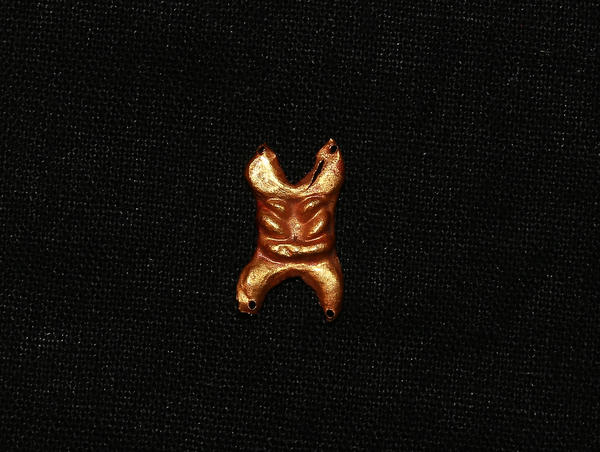
The sewn-on appliqué was found in the BEra mound near the KOsika village in the YenotAyevsky District. This burial was opened and destroyed in 1984, when a water culvert trench was laid there.
The appliqué is made in the shape of a ram skin with a knot in the middle and holes for sewing onto the fabric. Such small formed appliqués are often found in the rich burial mounds of the Sarmatian culture. They were used to decorate clothes or burial covers: they were sewn onto the fabric through small holes or eyes. As a rule, appliqués of different shapes may be found in one mound. This suggests that they were sewn onto the fabric in a certain order to design various decorative compositions.
Scientists quite often find appliqués with zoomorphic motifs such as images of animals. This is a so-called animal style. The Sarmatians decorated their jewelry and horse harnesses, dishes and clothes buckles with symbolically-rendered images of animals. The ram was one of the most popular animals as it was very important for the everyday life of nomads. There are various items outlining a ram’s head, decorative horns or an image of an entire animal. Our object is a styled ram skin twisted in the middle of the appliqué. This pattern is called a Hercules knot. The ram personified “heavenly grace” in the Iranian mythology.
The women’s clothes of an ordinary representative of the nomadic population of the Sauromat-Sarmatian period probably were more or less the same as the men’s. This is explained by the fact that nomadic women had to wear clothes that were comfortable for riding. The Sarmatian society respected and honored women. Women served as priestesses and sometimes even participated in hostilities. Ancient authors wrote about such facts. For example, Herodotus reported that Sarmatian women “were hunting either with their husbands or alone, went to war and was wearing the same clothes as men.”
In 2005, the sewn-on appliqué from the Astrakhan Museum Reserve collection was exhibited at the Astrakhan Steppe Treasures show at the National Museum of the Palazzo Venezia in Rome.