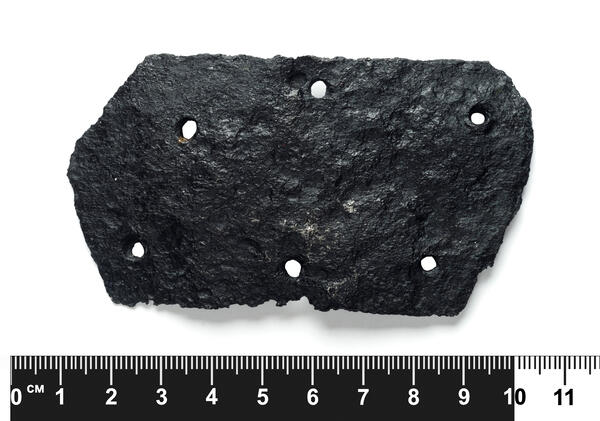
The permanent exhibition “Relics from the Battle of Kulikovo” presents a fragment of an iron trapezoid plate of armor of the 12th–14th centuries with rounded lower corners. The body of the plate has six rounded holes with the diameter of 0.4–0.6 cm. Possibly, the seventh hole was located in the lower right corner. The plate is 0.15–0.2 cm thick.
The plate was discovered during a joint archaeological expedition of the State Historical Museum and the State Museum-Reserve “Kulikovo Field”, to the south of the Monastyrshchino village, on the watershed of the Rybiy Verkh ravine and the Smolka River in 2000.
This plate could be part of a lamellar armor, in which the plates were fastened to each other with leather straps, thereby forming a flexible and reliable armor protection of the warrior’s body. Such plates, as a rule, were located in the lower part of the armor or made up lamellar skirts that were attached to the body.
The closest analogues of this form of armored plates are found among Novgorod artifacts of the 13th–14th centuries, the Old Russian weapons workshop of the 13th century in the city of Gomel, and excavations of the Lower Castle of Vilnius. This type of protective armor was used from the 13th to the first half of the 15th century.
At the time of the Battle of Kulikovo, protective weapons were an integral part of a warrior’s equipment. Moreover, from the second half of the 14th century onwards, the weight of body armor increased throughout Eurasia.
The find is an armor of the “brigandine” type. This is a garment lined in the inside with small-plate armor sewn or riveted to the fabric. This type of armor originated in Western Europe and was widely used both in Western and Eastern Europe, as well as in the countries of the Muslim world. Experts claim it appeared in the last third of the 14th century, and it went out of use in the second half of the 16th century. Perhaps it was this type of armor that the Grand Prince Dmitry Donskoy was using during the battle — “The Tale of Mamai’s Defeat” mentioned that the Prince was “all beaten and sore, but on his body he found mortal wounds nowhere.”
The plate was discovered during a joint archaeological expedition of the State Historical Museum and the State Museum-Reserve “Kulikovo Field”, to the south of the Monastyrshchino village, on the watershed of the Rybiy Verkh ravine and the Smolka River in 2000.
This plate could be part of a lamellar armor, in which the plates were fastened to each other with leather straps, thereby forming a flexible and reliable armor protection of the warrior’s body. Such plates, as a rule, were located in the lower part of the armor or made up lamellar skirts that were attached to the body.
The closest analogues of this form of armored plates are found among Novgorod artifacts of the 13th–14th centuries, the Old Russian weapons workshop of the 13th century in the city of Gomel, and excavations of the Lower Castle of Vilnius. This type of protective armor was used from the 13th to the first half of the 15th century.
At the time of the Battle of Kulikovo, protective weapons were an integral part of a warrior’s equipment. Moreover, from the second half of the 14th century onwards, the weight of body armor increased throughout Eurasia.
The find is an armor of the “brigandine” type. This is a garment lined in the inside with small-plate armor sewn or riveted to the fabric. This type of armor originated in Western Europe and was widely used both in Western and Eastern Europe, as well as in the countries of the Muslim world. Experts claim it appeared in the last third of the 14th century, and it went out of use in the second half of the 16th century. Perhaps it was this type of armor that the Grand Prince Dmitry Donskoy was using during the battle — “The Tale of Mamai’s Defeat” mentioned that the Prince was “all beaten and sore, but on his body he found mortal wounds nowhere.”