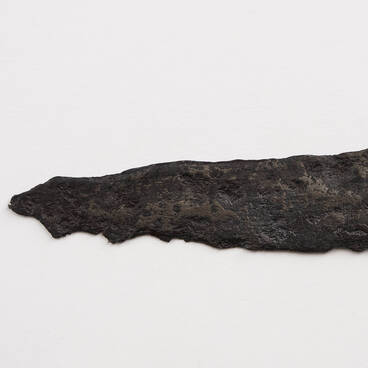
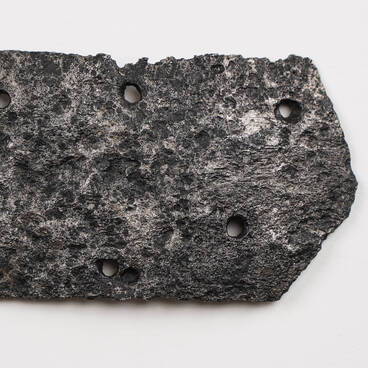
The permanent exhibition “Relics from the Battle of Kulikovo” includes a spearhead — a part of a pole weapon used for piercing and cutting during the 12th–15th centuries. The spearhead is 32.7 cm long, the widest part of the body is 4.2 cm, and the diameter of the socket is 2.8 cm. The spearhead has a socket, and a rhomboid body, which is also rhomboid in cross section. The elongated body is triangular in shape with characteristic beveled shoulders. The socket is octagonal and has holes for attaching to the pole. The arrowhead is distinguished by the socket and body, which are quite large in terms of proportions and size.
The spearhead belongs to the type of elongated-triangular spears widespread from the 12th to the first half of the 15th century (type III-a according to A.N. Kirpichnikov). These spearheads appeared in the late 11th century, as equestrian spear fighting against an enemy protected by chain mail or plate armor became common. Later, this type was finally replaced by spears with narrow points, adapted mainly to fight the enemy protected by chain mail. In the 13th and 14th centuries, this type of spear belonged to the most important weapons of a professional warrior. It is very unlikely to be associated with the fishing equipment that could belong to the local population living on the territory of Kulikovo field from the early 13th to the late 14th century. Thus, this is one of the best finds of a weapon from the territory of the Kulikovo field associated with the battle in 1380.
For ramming, mounted warriors used a spear. The shafts could be up to 2.5 meters long and were made of solid wood. The end opposite to the tip was reinforced with an iron “vtok”. Armor-piercing spearheads become prevalent in the time of the Battle of Kulikovo. The increasing role of piercing weapons in the 14th century led to the creation of special spear units. An army’s size was often counted in “spears”.
Archaeologists often find spearheads both in burials and at the sites of ancient battles. The number of these finds is second only to the number of discovered arrowheads.
This arrowhead was discovered near the village of Khvorostyanka, Kurkinsky District, Tula Oblast, on the Kulikovo field in 1956 by a local resident N.G. Trofimov. It is stored in the collection of the state cultural institution — Association “Tula Historical, Local Lore and Art Museum”. The State Museum-Reserve “Kulikovo Field” houses a replica made in 2002.
The spearhead belongs to the type of elongated-triangular spears widespread from the 12th to the first half of the 15th century (type III-a according to A.N. Kirpichnikov). These spearheads appeared in the late 11th century, as equestrian spear fighting against an enemy protected by chain mail or plate armor became common. Later, this type was finally replaced by spears with narrow points, adapted mainly to fight the enemy protected by chain mail. In the 13th and 14th centuries, this type of spear belonged to the most important weapons of a professional warrior. It is very unlikely to be associated with the fishing equipment that could belong to the local population living on the territory of Kulikovo field from the early 13th to the late 14th century. Thus, this is one of the best finds of a weapon from the territory of the Kulikovo field associated with the battle in 1380.
For ramming, mounted warriors used a spear. The shafts could be up to 2.5 meters long and were made of solid wood. The end opposite to the tip was reinforced with an iron “vtok”. Armor-piercing spearheads become prevalent in the time of the Battle of Kulikovo. The increasing role of piercing weapons in the 14th century led to the creation of special spear units. An army’s size was often counted in “spears”.
Archaeologists often find spearheads both in burials and at the sites of ancient battles. The number of these finds is second only to the number of discovered arrowheads.
This arrowhead was discovered near the village of Khvorostyanka, Kurkinsky District, Tula Oblast, on the Kulikovo field in 1956 by a local resident N.G. Trofimov. It is stored in the collection of the state cultural institution — Association “Tula Historical, Local Lore and Art Museum”. The State Museum-Reserve “Kulikovo Field” houses a replica made in 2002.