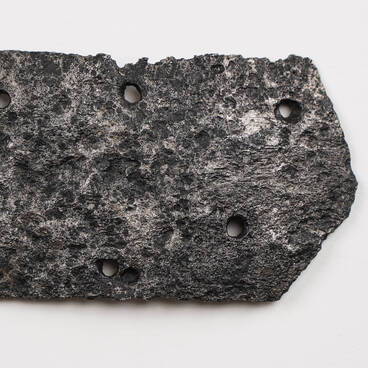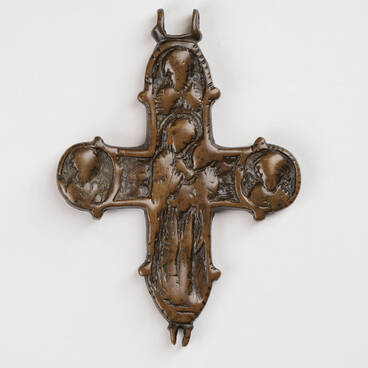
The bow and arrow is the oldest range weapon. In Old Rus, the bowstring was made from plants, silk thread and rawhide. The bow was carried on the left in a leather bag called “naluchye”, and the quiver, or “tul”, was carried on the right. Craftsmen who made the “tul” were called “tulniki”. Sometimes quivers were decorated with elegant bone plates with carved patterns and animal images. In the 14th-century Rus, the quiver could hold no more than 20 arrows. The Golden Horde warriors had up to 30 arrows, and in battle they would use two quivers: for 30 armor-piercing arrows and for 30 forked ones. When shooting, warriors protected their hands from injury with the help of gloves, shoulder pads, and wrist splints. In combat, the distance of the arrow flight was no more than 100–150 meters.
In Old Rus, the shaft of arrows was made from pine, spruce, birch or apple trees. Old trees were preferable. The Old Russian arrows could be from 75 to 90 cm long. Fletching was used to stabilize the shaft during flight.
Arrowheads were crucial to inflicting damage. In the Middle Ages, they were almost always made from iron. In cross section, flat arrowheads had the shape of a thin lens or a very narrow rhombus. In Old Rus, most arrowheads belonged to this group.
In the 12th–14th centuries, arrowheads included various points with a wide blade for close-range shooting at the exposed parts of the enemy and his horse, armor-piercing arrows, and crossbow bolts. Bowyers chose the shape depending on the intended purpose of each bow. Arrowheads with a solid narrow arrowhead were intended for piercing chain mail and other armor, and arrowheads with a wide tip were used to shoot at an unprotected enemy. Arrows with the widest tips were used against enemy cavalry.
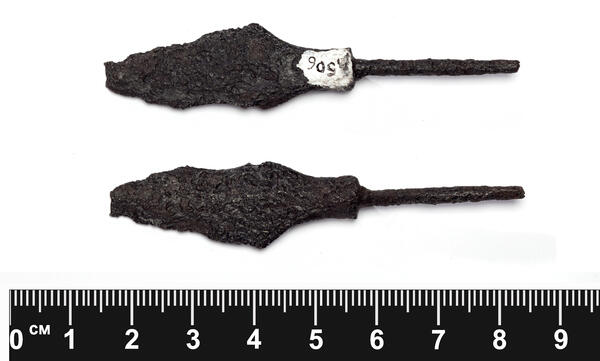
In 1995, the villagers of Samokhvalovka in the upper reaches of the Sredny Dubik ravine found this arrowhead on one of the probable retreat routes of Khan Mamai’s defeated army. The arrowhead has a tang, a wide rhombus-shaped asymmetric body with a flange made in the swaging. The cross section of the body is close to a flattened rhombus, almost a lens, while the cross section of the tang is close to a circle. The preserved arrowhead is 6.8 cm long.
In Old Rus, the shaft of arrows was made from pine, spruce, birch or apple trees. Old trees were preferable. The Old Russian arrows could be from 75 to 90 cm long. Fletching was used to stabilize the shaft during flight.
Arrowheads were crucial to inflicting damage. In the Middle Ages, they were almost always made from iron. In cross section, flat arrowheads had the shape of a thin lens or a very narrow rhombus. In Old Rus, most arrowheads belonged to this group.
In the 12th–14th centuries, arrowheads included various points with a wide blade for close-range shooting at the exposed parts of the enemy and his horse, armor-piercing arrows, and crossbow bolts. Bowyers chose the shape depending on the intended purpose of each bow. Arrowheads with a solid narrow arrowhead were intended for piercing chain mail and other armor, and arrowheads with a wide tip were used to shoot at an unprotected enemy. Arrows with the widest tips were used against enemy cavalry.
In 1995, the villagers of Samokhvalovka in the upper reaches of the Sredny Dubik ravine found this arrowhead on one of the probable retreat routes of Khan Mamai’s defeated army. The arrowhead has a tang, a wide rhombus-shaped asymmetric body with a flange made in the swaging. The cross section of the body is close to a flattened rhombus, almost a lens, while the cross section of the tang is close to a circle. The preserved arrowhead is 6.8 cm long.