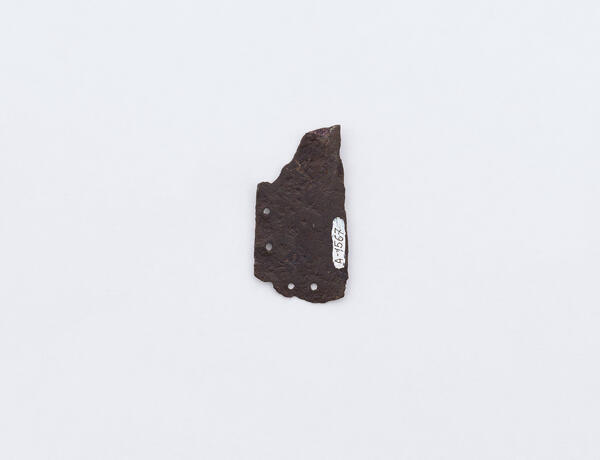
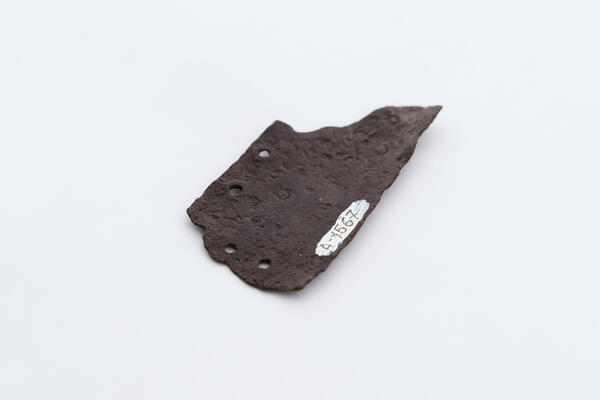
The exhibition at the State Museum-Reserve “Kulikovo Field” includes an iron plate, which makes part of armor from the 14th to 16th centuries. The plate has a flat, rectangular shape and small mounting holes along the upper and right edges. While the plate seems to be generally fairly well preserved, the lower part has been lost and the upper right mounting hole has been destroyed. There are five mounting holes along the upper edge of the plate and a rivet in its center, which helped secure it to its base.
Based on these design features, especially the fact that the mounting holes are arranged along the perimeter on three sides (with the third side with mounting holes missing from this particular item), it can be inferred that the plate on display is a rim plate, meaning it was located at the end of a row.
By the beginning of the Battle of Kulikovo era, plate-and-stitched armor had almost completely replaced all other types of armor, with the exception of chain mail. The emergence and subsequent spread of plate armor was due to the development of new technology by metallurgists at the turn of the 1340s, which allowed for the mass production of sheet metal. This armor is made from plates that are fastened together, giving it a more flexible design. This armor was assembled on thin leather or fabric strips, with gaps between them allowing for flexibility.
The armor systems of previous eras, such as lamellar and annular ones, suggested a rather primitive level of metalworking technologies. As blacksmiths mastered new techniques, those systems gave way to plate-and-stitched armor. Dmitri Donskoi, for example, wore plate-and-stitched armor during the Battle of Kulikovo. In particular, “The Tale of Mamai’s Defeat” states that after the battle, the Grand Prince’s armor was “all beaten and ulcerated, ” yet the prince himself did not have any mortal wounds on his body. Though scales of plate-and-stitched armor did sometimes have traces of impacts, they still provided better protection compared to other types of armor.