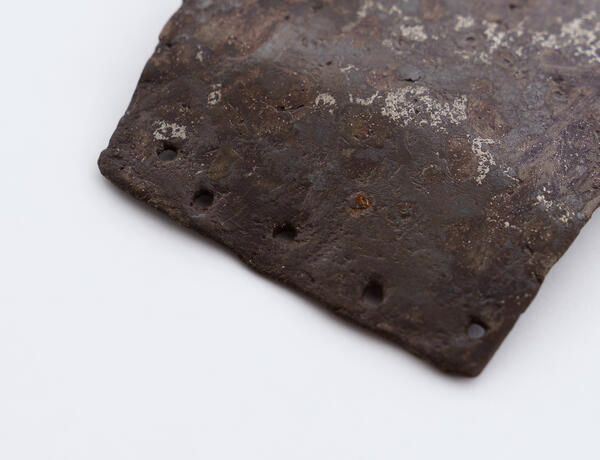
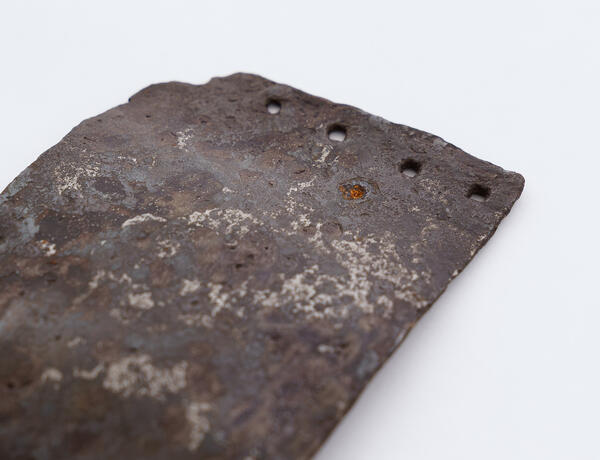
The iron plate on display at the State Museum-Reserve “Kulikovo Field” is a part of armor from the 14th–16th centuries. It is flat and of an irregular trapezoidal shape. There are five mounting holes along the upper edge of the plate, with another hole located in the center on the right side. This hole and the overall shape of the plate indicate that it may have been located at the end of a row.
During the time of the Battle of Kulikovo, armor was an essential part of a professional warrior’s equipment. Experts note that there was a significant increase in the weight of armor throughout Eurasia from the second half of the 14th century, due to a major leap in metalworking technology.
The presented find is a main armor set of the rivet-and-stitched type. This type of armor can be divided into two categories: the first one was made on top of a base and is called “scale” by today’s arms researchers; the second one was made beneath the base, and was known as “brigantine” in Europe and “kuyak” in Russia.
Both types of armor were widely used since the 1340s and, beginning with the second half of that century, they had almost completely replaced other types of plate armor thanks to the mass production of sheet iron for cutting plates for such coats-of-plates.
Despite the fact that by the time of the Battle of Kulikovo, plate armor had over a thousand years of development, and the main components of the armor changed shape, size, and method of connection multiple times, the design of this type of armor remained relatively archaic. Russian knights did not cover their armor with cloth or leather until the 15th century. It was believed that the shine of the metal increased the psychological pressure on the enemy.
Mongol lamellar armor remained almost unchanged up until the 15th century. It consisted of overlapping plates that were attached to longitudinal leather belts using straps. The transverse planks of such armor were also made of separate metal plates, though they could be made of leather, as well. Leather plates were generally painted and varnished.