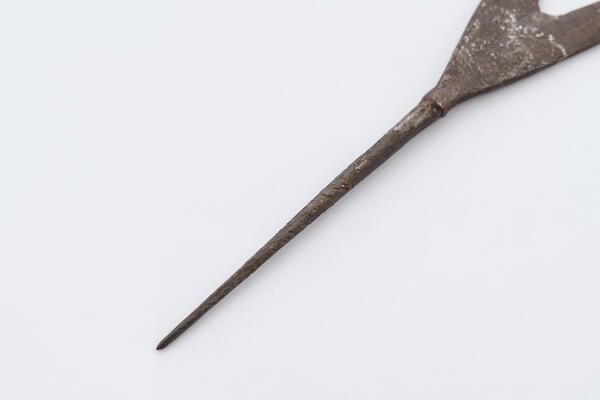
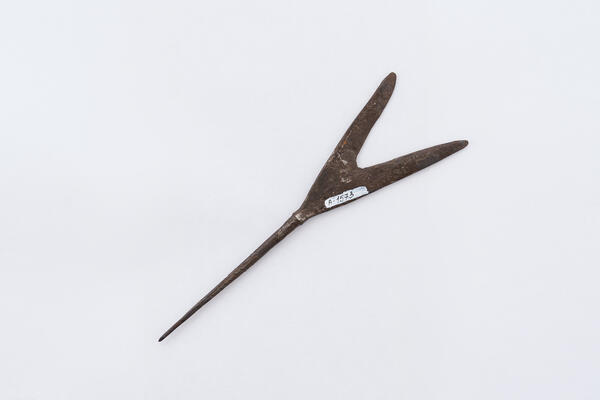
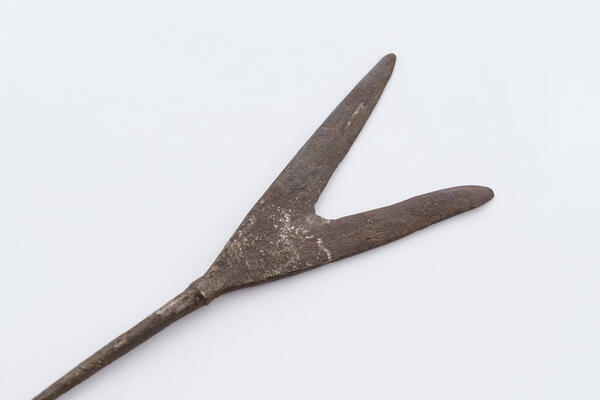
The museum collection includes a tanged forked arrowhead. This is part of an arrow for a composite bow used in the 13th–14th centuries. The artifact features a V-shaped head and an elongated tang. The transition from the arrowhead to the tang was swaged.
Throughout the 13th and 14th centuries, the design of arrowheads continued to evolve. By the time of the Battle of Kulikovo, there were already many arrow types with various arrowheads.
This type of artifact is referred to as a forked arrowhead. It was designed for use against lightly armored enemy forces as well as horses.
Long-distance archery was a key tactic used by nomadic warriors. It was shooting arrows that enabled the Mongols and Tatars to achieve victories and conquer new territories. The bow and arrow functioned as long-range weapons that played a significant role in the arsenal of Horde warriors. Tatar-Mongol archers were famous for their incredible shooting accuracy and exceptionally high efficiency.
Like Russian bows, Mongol bows were also composite. Tatar-Mongol warriors used long arrows, with the shafts typically painted red. The shapes of the arrowheads were diverse, ranging from wide leaf-shaped to chisel-shaped or narrow armor-piercing designs.
In Russia, arrow shafts were made from pine, spruce, birch, or apple wood, preferably, from older trees. Fletching was used to stabilize the flight of an arrow. The lethality of shots depended greatly on the arrowhead that was used. During the 12th–14th centuries, there was a variety of forked arrowhead shapes designed for short-distance shooting at the unprotected areas of the bodies of warriors and horses, as well as armor-piercing arrows and crossbow bolts.
An integral part of an archer’s equipment was a quiver, known as a “tul” in Russian. Craftsmen who made these quivers were referred to as “tulniki”. Occasionally, quivers were decorated with elegant bone plates featuring carved and often painted patterns and images of animals. In the 14th century, a Russian warrior could carry no more than 20 arrows in their quiver, while Horde warriors could carry up to 30 arrows. In combat, the Golden Horde warriors would carry two quivers with 30 armor-piercing arrows and 30 forked ones.