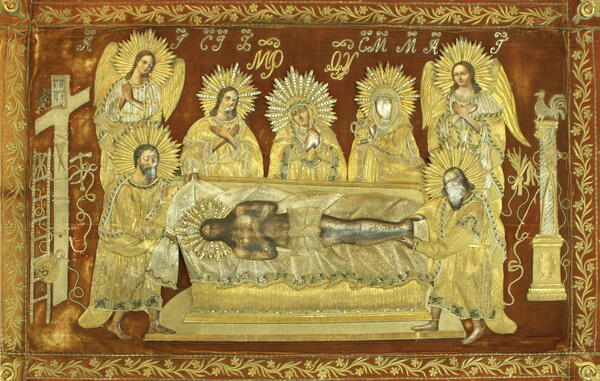
The term “Holy Shroud” refers to a large covering depicting the burial of Jesus Christ or the Virgin Mary.
The origin of the name “Holy Shroud”, associated with the image of the “Placement in the Tomb of Our Lord Jesus Christ, ” is linked to the remembrance of the events of Great Friday and Great Saturday, as mentioned in the four Gospels.
In modern times, the image of the deceased Savior is carried out at the end of the evening service on Great Friday, which is held at the third hour of the day, the hour of Jesus Christ’s death on the cross. The clergy sing, “The honorable Joseph, taking down Your pure body from the wood, wrapped it in a clean shroud and covered it with spices in the new tomb, ” or “The honorable Joseph, having taken down Your pure Body from the cross, wrapped it in a shroud and anointed it with perfumes, laid it in a new tomb.” At the same time, they lift the Holy Shroud from the altar, as if from Golgotha, and carry it to a prepared table — the “tomb, ” where all present in the church bow to the resting Lord.
The carrying of the Holy Shroud and the Burial Service are two of the most important liturgical services performed on Great Friday of Holy Week. At the end of this remarkable rite, a procession around the church is held, accompanied by the singing of the burial prayer “Holy God…”.
At the front of the procession, the priests carry the Holy Shroud. In this way, the faithful accompany and bury the Savior. Until the Paschal Vigil (midnight on Sunday), the image of the resting Christ remains in the church, after which it is taken into the altar and placed on the altar table. It rests there until the feast of the Leave-Taking of Pascha (the eve of the Ascension).
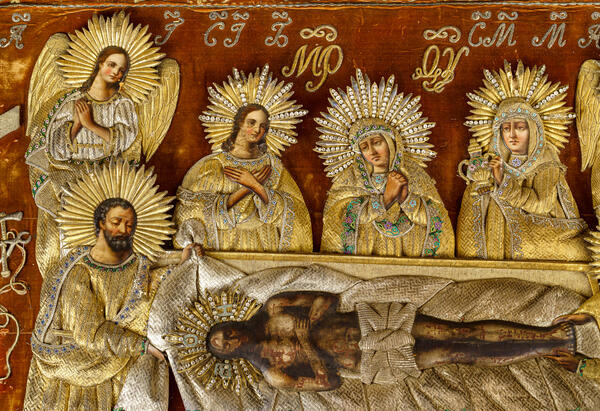
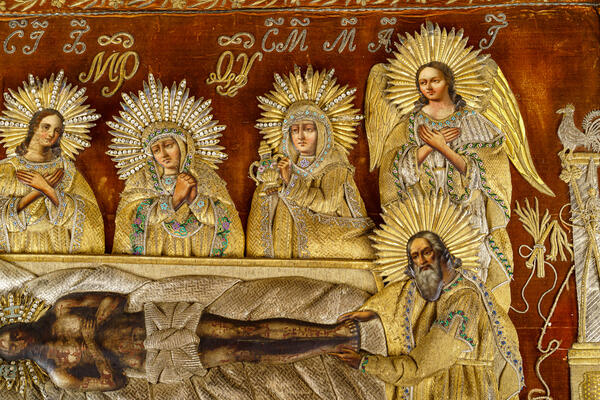
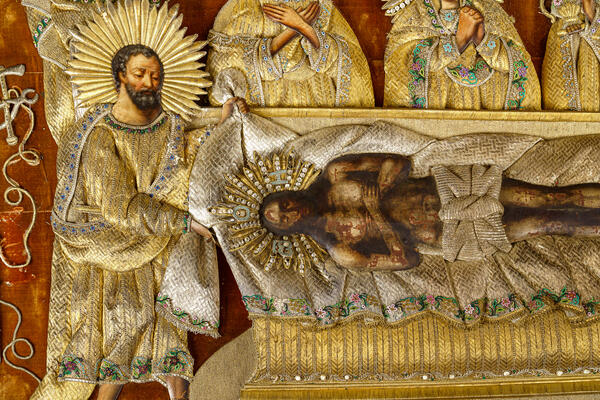
On this Holy Shroud, the Savior is depicted lying in the tomb, naked, in a loincloth. He is surrounded by figures of angels, the Virgin Mary, Mary Magdalene, the Apostle Peter, John the Theologian, and Joseph of Arimathea.
The naked body of the Savior
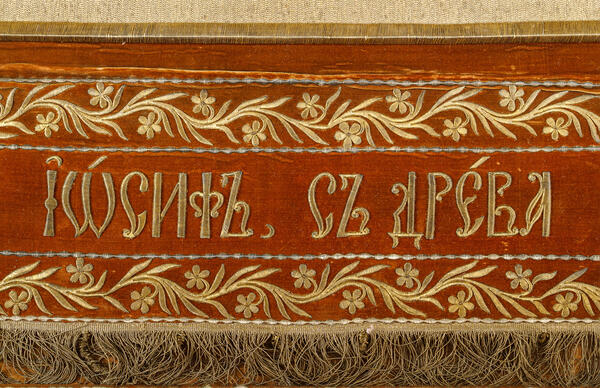
is laid in the tomb, His eyes closed, and His hands crossed. Around the edge of
the cloth, the text of the troparion of Great Saturday is embroidered in gold,