Font
Color
Graphics
Изображение точки

To see AR mode in action:

1. Install ARTEFACT app for iOS or Android;

2. Find the exhibition «The History of the Sarov Monastery»

3. Push the «Augmented reality» button and point your phone's camera at the exhibit;

Скрыть точки интересаПоказать точки интереса
Показать в высоком качестве

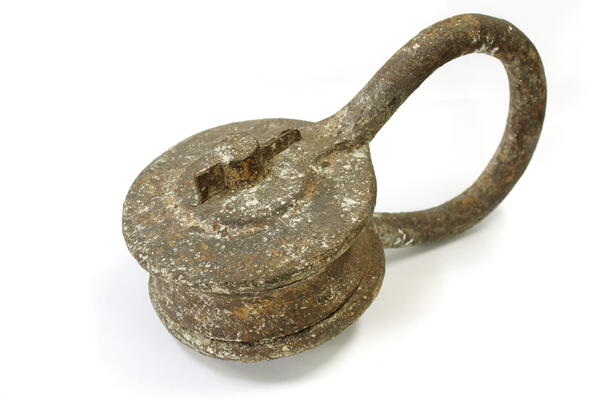
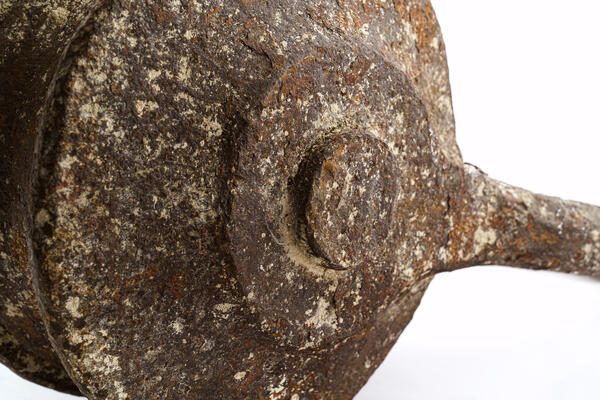
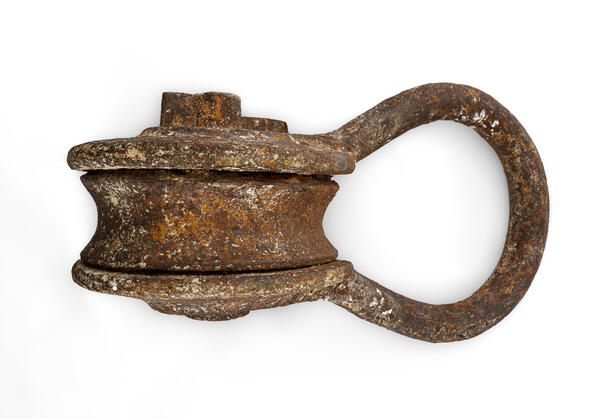
Block for raising church bells

Creation period
the late 19th century
Place of сreation
the Russian Empire
Dimensions
60x32x22 cm
Technique
cast iron
Collection
0
Open in app
#2

A block is a simple mechanical device that allows for the regulation of force. It consists of a wheel with a groove around its circumference, rotating around its axis. The groove is designed for a rope, chain, belt, or other materials.

The block displayed in the Museum of Sarov was used in the monastery for construction work and for raising bells to the belfry. It was acquired by the museum in 1966.

There are memories of the bell raising in the “Notes of Hieromonk Evgeny.” These are cited in the book “Sarov: A Monument of History, Culture, and Orthodoxy” by Alexey Mikhailovich Podurets,

#8

On September 15, 1801, the foreman Nikita Kondratiev arrived from Moscow to raise the bells, and he began preparations for removing the bells on the 16th; on the 17th, he lowered the smaller bells from the old belfry, and on the 18th, he lowered the 100-pood (1 pood being equal to 16.38 kilograms), the 200-pood, and the 300-pood bells, which he moved to the new belfry that same day. On the 19th, he prepared the rigging for raising the bells to the belfry and, after blessing the water and sprinkling all the bells with it, fixed the 200-pood bell and successfully raised it to the third floor. On the 20th, that is, on Friday afternoon, they raised the 500-pood bell to the third floor, and the 200-pood and 300-pood bells to the fourth floor, while on Saturday, preparations were made to hang them in place. On the 22nd, that is, on Sunday, they hung the 300-pood bell in its place, and the 500-pood bell was brought to the fourth floor; they intended to hang it in place, but the block broke, so it was successfully hung on Monday, the 23rd, in the morning, thank God, and in the afternoon, the 200-pood and the 100-pood ones were hung. On the 24th, they hung the 80-pood bell and all the smaller bells, attached all the clappers, and they rang all the bells. The bells were raised by all the local folks; the announcement had been made in the following villages: in the village of Balykovo, in the village of Kremyonki, in the villages of Ruzanovo, Knyaz Ivanovo, and Sinovka, in the village of Yelizaryevo, Lomasovo, and others surrounding this monastery. However, the peasants from Count Tolstoy’s village of Yelizaryevo and his other villages worked the hardest to raise the bells, with many of them being factory workers, as there is a cloth factory in Yelizaryevo. On September 27, foreman Nikita Kondratiev, who had the bells raised, left the monastery for Moscow in the morning; he was of medium height, bald, and had a medium-sized gray beard.

#9
Thus, with the help of blocks, the bells were raised to the heavens. The height of the belfry in Sarov, including the cross, is about 85 meters.


According to pilgrims from the early 20th century, on dry, clear days, the sound of the Sarov belfry could be heard as far away as the village of Diveyevo (approximately 17 kilometers away).

#10
Block for raising church bells
#3
View in the State Catalogue
read morehide
00:00
00:00
1x

Block for raising church bells

Creation period
the late 19th century
Place of сreation
the Russian Empire
Dimensions
60x32x22 cm
Technique
cast iron
Collection
0
Point your smartphone camera to open in the app
Share
VkontakteOdnoklassnikiTelegram
Share on my website
Copy linkCopied
Copy
Open in app
To see AR mode in action:
  1. Install ARTEFACT app for 
  2. iOS or Android;
  3. Find and download the «Paintings in Details» exhibition
  4. Push the «Augmented reality» button and point your phone's camera at the painting;
  5. Watch what happens on your phone screen whilst you flip through the pictures.
 
We use Cookies
Cookies on the Artefact Website. We use cookies to ensure that we give you the best experience on our website. If you continue without changing your settings, we'll assume that you are happy to receive all cookies on the Artefact website. However, if you would like to, you can change your cookie settings at any time.
Learn more about useHide
Content is available only in Russian

X

Нашли опечатку?...

%title%%type%