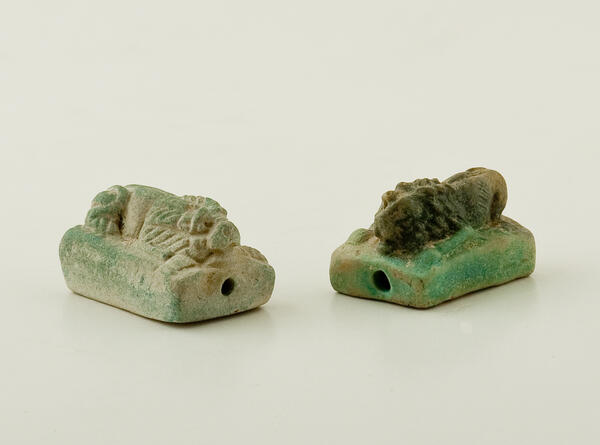
When exploring the archaeological exhibition at the Volgograd Regional Museum of Local Lore, you can see glazed surface decorations in the form of plaques depicting reclining lions, scarabs (dung beetles), and various pendants. These items first appeared in the Lower Volga region during the Sarmatian period. The material from which these objects are made is commonly referred to as Egyptian faience. Faience was invented 4000 years ago in the ancient Near East, in Mesopotamia or Egypt, which is where the name originates. It allowed for the mass production of jewelry imitating precious stones.
Jewelry made of Egyptian faience was especially widespread in the Northern Black Sea region from the 1st century BC and in the first centuries AD. The fact that some of the jewelry features Egyptian hieroglyphs suggests that they continued to be produced in Egypt.
There are several theories on how such items could have reached the Lower Volga steppes. One of the most widely accepted ones connects the arrival of these items to the Sarmatians through the ancient city-colonies of the Northern Black Sea region via the intermediary trade of Greek cities in Asia Minor and the Aegean islands.
From the early centuries AD, when Sarmatian tribes entered into permanent trade relations with the population of ancient cities, Egyptian faience jewelry made its way to the steppes as a result of this trade exchange.
Two rectangular flat plaques with three-dimensional figures of reclining lions made of Egyptian faience were found near the village of Peregruznoe in the Oktyabrsky district.