Almost all medieval cities contained so-called Kashan ceramics among other finds within the cultural layer of the 13th-14th centuries, Kashan refers to a lightweight and porous ceramic mass that has a white color with faint yellow or pinkish hues after firing. The term “Kashan” likely originates from the name of the Iranian city of Kashan, where in the 12th century white-clay vessels were made from a type of faience and semi-faience intended for luster painting (luster painting involves using organic lacquers containing special compounds of iron, titanium and other metals. During the firing process, the organic substances burn away leaving a thin (a few microns) metallic or metal-oxide coating on the surface of the glaze which possesses a high gloss and unusual color).
The centers of Kashan ware production were the cities of medieval Iran, Khwarezm and the Golden Horde. Such ceramic ware is a component of the trade and cultural connections between various states, marking its owners as belonging to the elite social class and serving as reliable dating material. The period of Kashan ware’s prevalence is limited to the 13th-14th centuries.
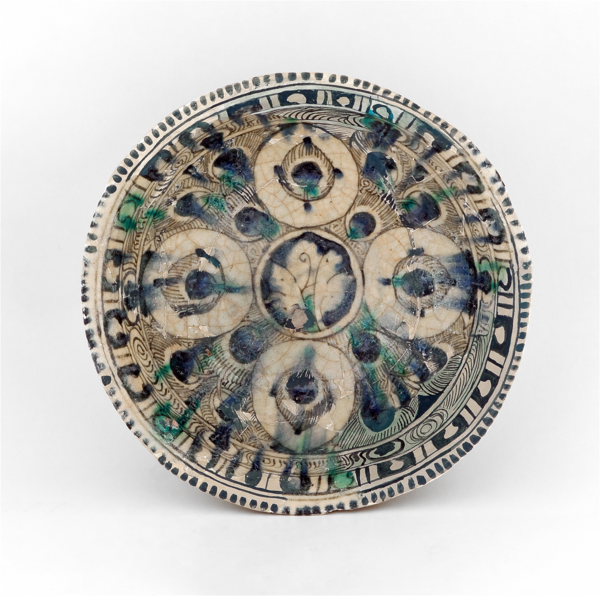
The bowl dates to the 14th century and was found at the Tsarev settlement in Leninsky District of Volgograd Region by an expedition led by Y.A. Zeleneev in 1996. The bowl is hemispherical with a flared rim on a ring base. The central part of the bowl is decorated with a circle featuring a white flower on a turquoise background and above the decoration, there is a frieze of vertical peacock feathers It is noteworthy that floral and plant motifs were the most common decorations in Golden Horde art.