


Non-ferrous metallurgy was highly developed in the Golden Horde, which was also artistic, numerous foundries, crucibles, smelting ladles, jewelry anvils and hammers, chisels, locksmith scissors, matrices, waste products, defective products were found. Waste from the bronze foundry was found not only in cities (Tsarevskoye and Vodyanskoye settlements), but also in rural settlements of the Golden Horde. Casting, embossing, embossing, engraving, and soldering techniques were used.
Non-ferrous metalworking products are represented by a large number of different types of products: buckles, overlays, patches, belt rings, tips and belt distributors, plaques, clips, pendants, medallions, sleigh bells, bells from the Tsarevskoye settlement. A large bronze bell is also known as well as buttons, clasps, caps, beads, chains, temple rings, earrings, colts, rings, hoops, tweezers, bow-pulling rings, bracelets, hairpins, sulgams, mirrors.
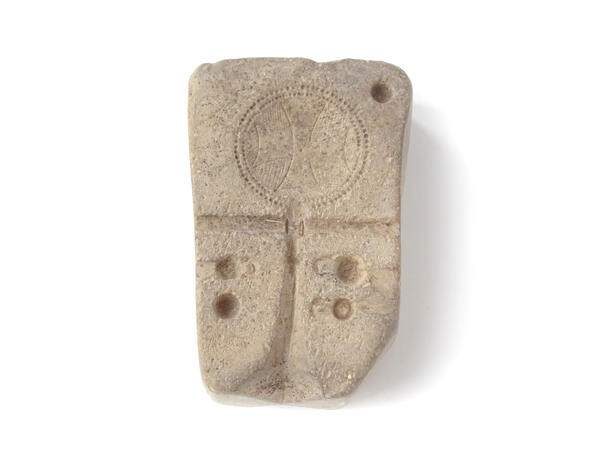
A two-sided casting mold in the form of a massive trapezoidal tile was found by G. A. Fedorov-Davydov in 1974 at the Vodyansk settlement near Dubovka, Dubovsky district. On one plane, a bed is carved for casting a round medallion, into which is inscribed the figure of a Maltese cross with a dot in the middle. The edge of the medallion is decorated with two belts of dot indentations.
The medallion was cast together with a loop for hanging. Several casting sockets have been preserved on the back of the mold.
In the center of the lower part there is a bed for casting a round medallion, in the center of which there is a six-petalled rosette inscribed in a circle. The edge of the medallion is decorated with two belts of dot indentations.


