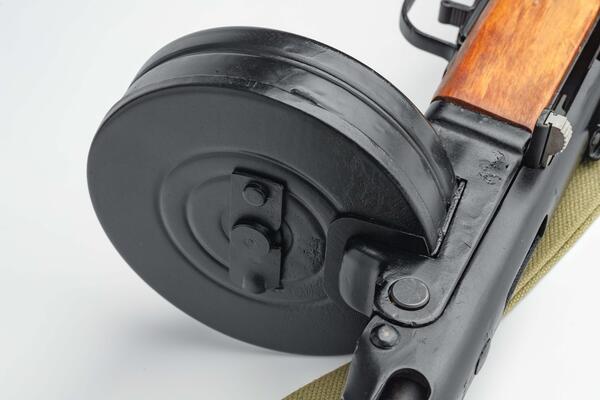
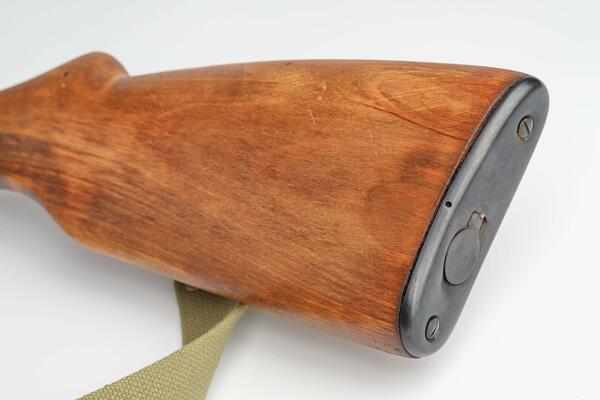
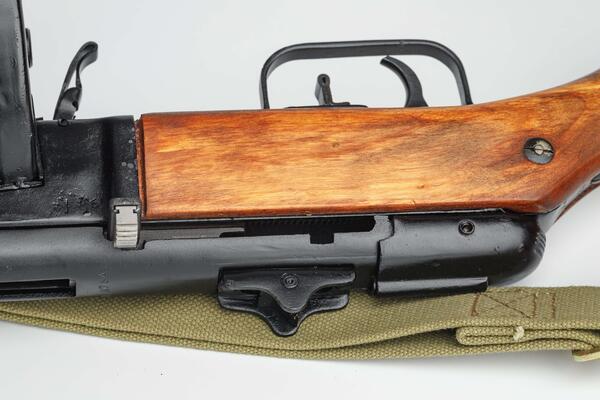
A model of the PPSh-41 submachine gun, designed by Georgy Semyonovich Shpagin, is on display at the Museum of Intelligence Officer Nikolai Ivanovich Kuznetsov. In 1940, the People’s Commissariat of Armaments issued a technical requirement calling for a new submachine gun that would match or exceed the tactical and technical performance of the Degtyaryov PPD-40. It was to be significantly simpler to manufacture — especially in non-specialized machine-building factories with limited tooling.
The resulting 7.62 mm PPSh-41 was chambered for the 7.62x25 mm Tokarev cartridge and officially adopted by the Red Army on the 21st of December 1940. Alongside the later PPS-43 designed by Alexei Sudayev, it became one of the two primary submachine guns of the Soviet Armed Forces during the Great Patriotic War.
The PPSh-41 was the most widely issued submachine gun in the Red Army and a staple weapon among Soviet partisans. It was also supplied to Allied forces under Lend-Lease and saw service with foreign military units operating on Soviet territory, including Polish and Czechoslovak formations. Units of the NKVD (People’s Commissariat for Internal Affairs) also employed the weapon extensively.
Its greatest advantage lay in ease of mass production: aside from the barrel, which required precision tooling, nearly all metal components were made by cold stamping from sheet steel. This allowed factories — even those previously producing consumer goods — to rapidly switch to weapons manufacturing. Moreover, the PPSh-41 could be fully disassembled and reassembled without tools; it contained no screws whatsoever.
Compared to its German counterpart, the PPSh-41 was not only simpler to produce but also more reliable in harsh field conditions. The German MP 40’s finely fitted parts were prone to jamming when exposed to mud, sand, or moisture — common hazards on the Eastern Front. In contrast, the PPSh-41’s generous tolerances and robust design ensured consistent operation even in such extreme environments.
Another key feature was its perforated barrel shroud, which served a dual purpose: it enhanced cooling during sustained fire and allowed soldiers to grip the weapon near the barrel with a bare hand without risk of burns. German troops, by contrast, often had to wear a protective glove on their left hand to handle the scorching barrel of the MP 40 during prolonged engagements.