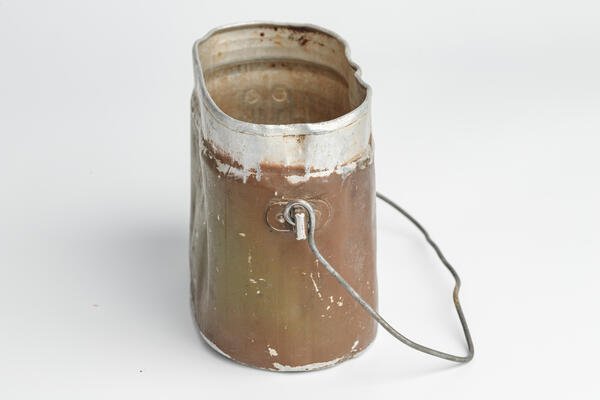
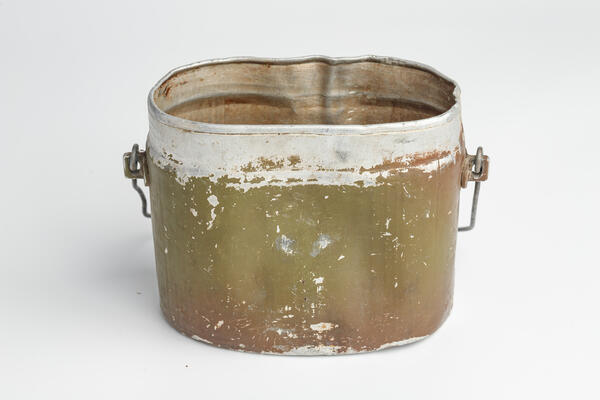
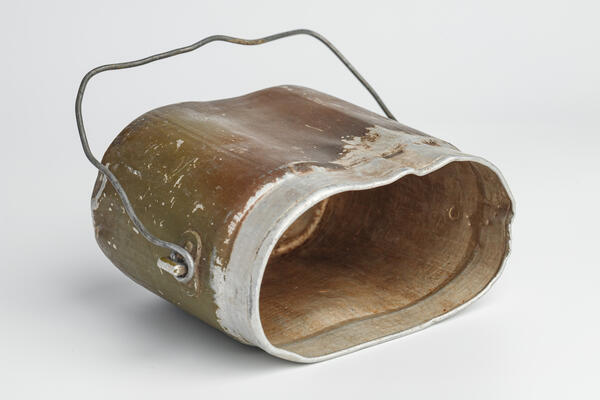
In the Museum of Intelligence Officer Nikolai Ivanovich Kuznetsov, among the many exhibits that preserve the spirit of wartime, visitors can see a seemingly simple yet deeply significant object — a Soviet field mess tin. For the soldier, this humble pot was a faithful companion: it endured the harshest conditions, fed him in battle and on the march, and became an inseparable part of daily life on the front line.
The standard Soviet army mess tin of the Second World War was a compact, durable piece of field cookware designed for cooking and eating in any environment — whether in a trench, forest, swamp, or steppe. It was typically made of thin-sheet galvanized steel or aluminum: lightweight, corrosion-resistant, and efficient at conducting heat. Aluminum versions — lighter and more prized — were often issued to infantrymen and scouts, whose missions demanded maximum mobility.
Every detail of the pot’s design was carefully considered. It had a rounded bottom and one flattened side, allowing it to be securely fastened to the soldier’s belt — the concave surface nestled snugly against the body without hindering movement. A folding wire handle made it easy to suspend the pot over a campfire or carry it by hand. The lid was far more than a cover: it doubled as a small frying pan for cooking potatoes, reheating porridge, or warming canned rations. The lid’s handle even included slots to hold a standard-issue tablespoon — ensuring the utensil was never lost and always within reach.
With a standard capacity of about one liter, the mess tin held just enough food for a single soldier. During field kitchen distributions, the cook would pour soup directly into the pot, while the second course and a portion of bread were placed in the lid. This system made meal service fast, efficient, and orderly, even in the chaos of combat.
More than just cookware, the mess tin became a symbol of soldierly camaraderie and resilience. Troops often paired up: one pot would simmer soup while the other boiled tea or cooked porridge. Many tins bear faint engravings on the bottom — a name, unit number, date, or a short wish — quiet traces of personal history that transform a utilitarian object into a genuine artifact of wartime life.
Production of these mess tins was organized across numerous factories throughout the USSR, including light-industry and metalworking plants converted for wartime needs. Despite material shortages and relentless production demands, quality remained high — as this pot had a direct impact on how well the soldier could endure the trials of war.