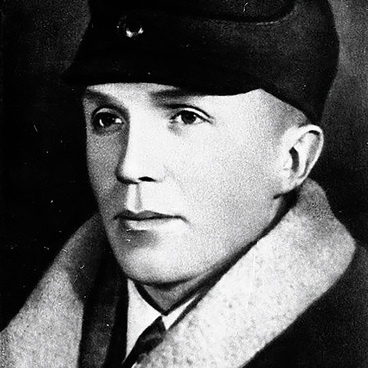
August 1942. The photograph on display captures a moment suspended in time: Nikolai Ivanovich Kuznetsov, clad in a flight helmet like a knight in armor, stands poised to leap into the very lair of the enemy. Ahead lies the unknown; behind him — his Motherland. In these final minutes before his flight behind enemy lines, the image encapsulates the full tragedy and heroism of war.
At the end of July 1942, Kuznetsov completed his specialized training and was formally assigned to the special-purpose reconnaissance and sabotage unit “The Winners”, commanded by Dmitry Nikolaevich Medvedev. The detachment was tasked with operating in the Rovno region.
According to the operational plan approved by the leadership of the 4th Directorate of the People’s Commissariat for Internal Affairs (NKVD), Kuznetsov was parachuted deep behind enemy lines on August 25, 1942, into the Sarny forests of the Rovno region, near Tolsty Les railway station — where “The Winners” had been stationed for several months.
Given the exceptional sensitivity of his mission, Kuznetsov was listed in Medvedev’s unit under the alias Nikolai Vasilyevich Grachyov, with the operational pseudonym “Pooh”. It was under this name that “Grachyov” would sign all his subsequent reports to the Center.
“The Winners” unit was led by seasoned commanders who had fought in the Russian Civil War: Colonel Dmitry Nikolaevich Medvedev and Major Sergei Trofimovich Stekhov. Medvedev himself had a lot of experience in intelligence. Tactical operations were overseen by the detachment’s deputy commander, Alexander Alexandrovich Lukin. From these veterans, Nikolai Kuznetsov absorbed invaluable knowledge — freely and generously shared by Medvedev, Stekhov, and Lukin alike.
In the detachment, Kuznetsov met comrades who would later assist him in Rovno: Mikhail Makarovich Shevchuk, Nikolai Akimovich Gnidyuk, Nikolai Vasilyevich Strutinsky, Valentina Konstantinovna Dovger, Nikolai Tarasovich Prikhodko, and others.
He further refined his spoken German under the guidance of Maria Alexandrovna Fortus, a major in state security and an experienced intelligence officer. In the unit, Fortus served as head of military intelligence and simultaneously as the detachment’s first party organizer. She remained with the unit until April 1943 and frequently accompanied Kuznetsov on missions to nearby villages, posing as his interpreter while presenting him as a newly arrived German commandant.
Vladimir Ivanovich Stupin, a fellow scout in the detachment, later recalled how convincingly Kuznetsov embodied the enemy — Stupin at times drew his portraits: