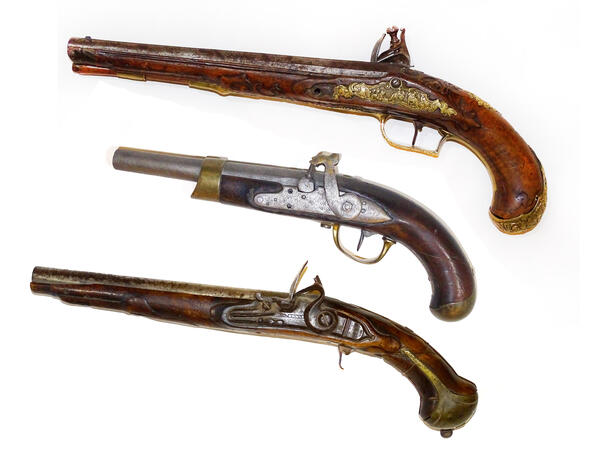
In Europe, the flintlock pistol was first massively used by the Spanish, who borrowed such a system from the Moors or Arabs. According to other versions, the birthplace of the creation of such design is considered to be Germany, Holland or Sweden. Each model had its advantages and disadvantages. This lock is based on a simple principle. Fueling powder is ignited under the sparks that arise after the strike of a metal frizzen on the flint. The popularity of such weapons was due to the fact that the need to use a smoldering fuse disappeared, while the system of the device became simpler than that of its wheel lock analogues.
Like many innovations, flintlock rifles and pistols were initially received with distrust. French King Louis XIV even forbade the use of this type of lock in the army on pain of death, so infantrymen continued to operate with a fuse, while the cavalry preferred the wheeled type of striker. Some gunsmiths managed to create combined versions with fuse and flintlock, but such models did not take root. Over time, constant refinements and modernization did their job, and the weapon became reliable and highly efficient for the time. German engineers succeeded most of all in this case. In Russia, such muskets began to be used in the army in 1700 under Peter the Great.