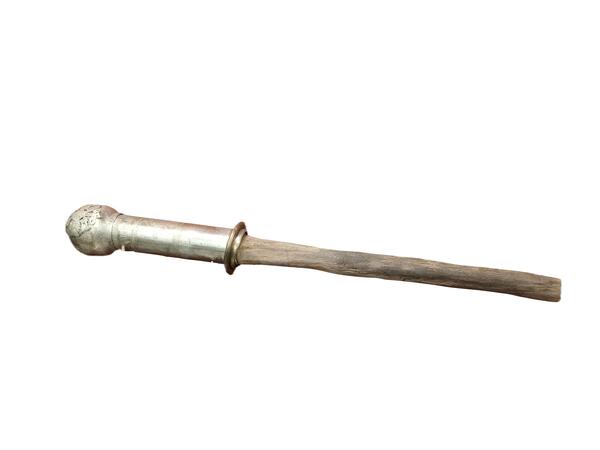
The museum holds the mace (naseka) of the village ataman of the Kobylanskaya village of the Army of the Don.
The ataman’s naseka is an attribute of power of the Cossack ataman — a long cane made of bough or smooth wood, colored under walnut, with a pommel and a tip. Originally, the straight stick was divided by notches according to the number of years of ataman’s service since the formation of the army. Ataman’s naseka was initially made of thorn or cherry trunk, making circular incisions on it during growth with a knife, which were covered with bark, forming twisted swells (hence the name — naseka). The names of the atamans who owned the item were also inscribed on the top. When an ataman was re-elected, the insect was handed over to his successor, only the top or the inscription on it was changed.
The Encyclopedic Dictionary of Brockhaus and Efron (edition of 1897) says that the insect is “a special badge of dignity in the Cossack troops, assigned by the highest approved on 10 May 1885 by the regulation of the Committee of Ministers of the post of village and settlement atamans”.
The naseka, as well as the mace and flanged mace, are personal insignia of atamans and petty officers of all levels and belong to the army kleinods (from the German word kleinod — jewellery, expensive thing). The first mention of the naseka is dated 1704, when Peter the Great granted the Don ataman, Cossacks and the whole army. According to the tsar’s decree, it was to be made “of simple wood, thick, half a third of an arshin in length (35,56 cm), and to be inscribed with walnut-colored paint to Ivan Petrov… and on that naseka at the top, on the frame, to carve the following: Naseka Voyska Donskogo 1704”.