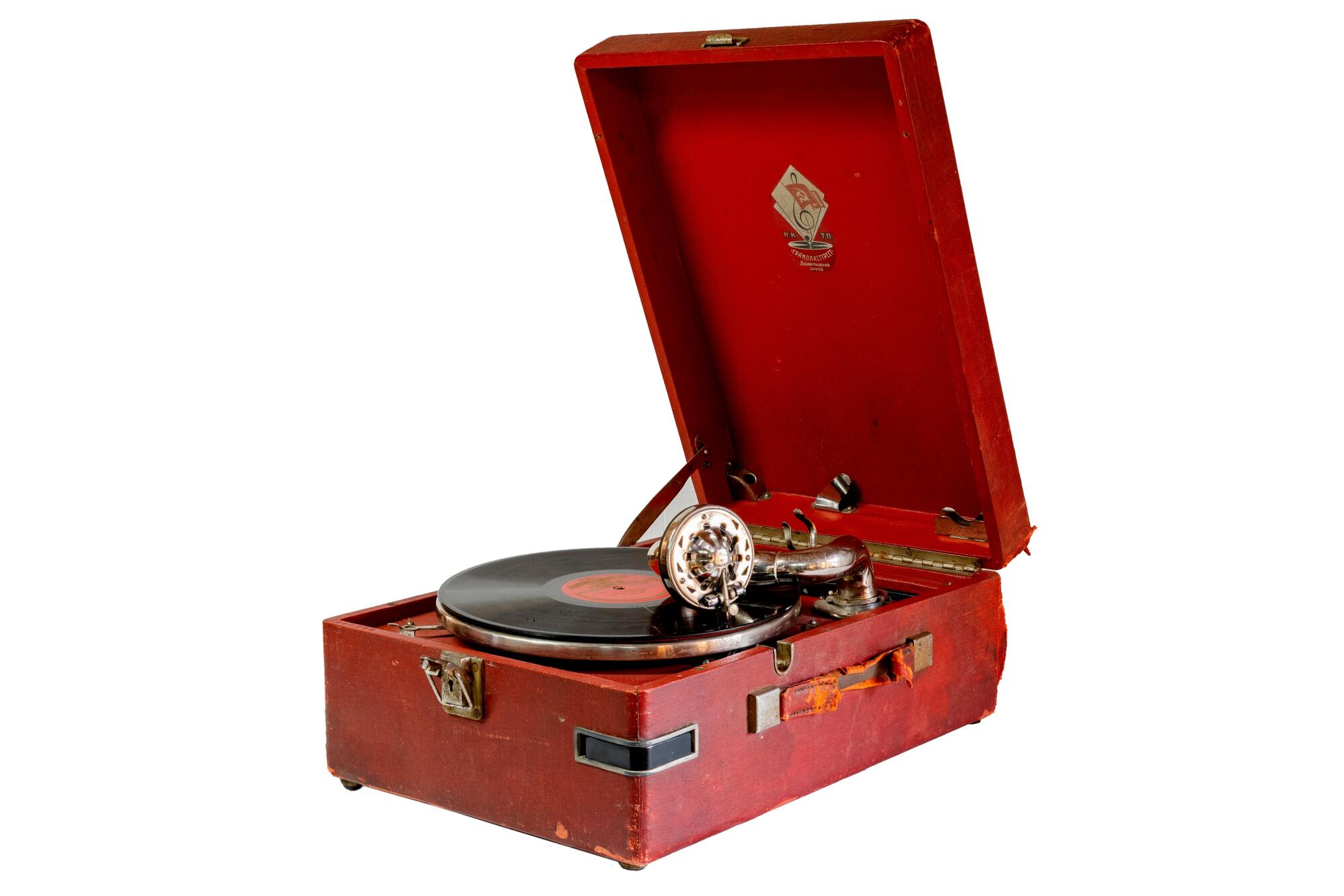


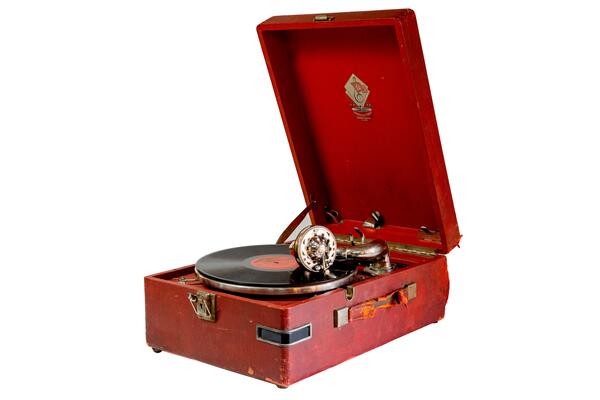
A portable gramophone, which is displayed at the exhibition of Nizhnevartovsk Museum of Local History was made in the 1940s in Vyatskiye Polyany, Kirov Region. A rectangular case, made in the form of a suitcase with a lid, contains a working mechanism and a turntable, where a recording was put. A hand crank is attached to an outer side of a case. It was used to play a portable gramophone. If necessary, it could be removed and put away into a special place inside a suitcase. The needle was also removable. It read the sound from a recording. The suitcase could be closed with a latch lock.
Portable gramophones were mechanical in the 1940s. The mechanism was started with a special spring, which was inside a body of a suitcase. A special regulator controlled the rotation of the disk. If necessary, it could be stopped with a hand brake. A lid of the case was open while the gramophone was playing. It was fixed with a special lid support hinge so that it would not shut accidentally.
During the existence of the USSR, there were several factories in Moscow, Leningrad, Kolomna, and Vladimir, which produced portable gramophones. One of such factories was Vyatskiye Polyany in the Kirov Region. It was opened in 1938, and at first, produced details for sewing machines. During the Great Patriotic War, an engineering plant from Zagorsk, which is located near Moscow, was evacuated to Vyatskiye Polyany. It started producing Shpagin machine pistols (PPSh). That enterprise assembled more than two and a half million of weapons. They used to be sent to the front for the Soviet officers. In September 1945, a factory was awarded the Order of Lenin for its hard work in wartime.
The process of peaceful production (including portable gramophones) was restored in Vyatskiye Polyany after the war. Anyway, they had been produced just for 10 years. By the middle of the 1950s, the demand for mechanical recorders had reduced. They were replaced by radios and electrophones. At the end of 1955, the factory stopped producing portable gramophones.
A model from the collection of Nizhnevartovsk Museum of Local History is still in working order. It is used during the “The War Songs” festival. Traditionally, this portable gramophone is used to play a recording with the song “Dark Night”. It has been stored in the museum since 1956.
Portable gramophones were mechanical in the 1940s. The mechanism was started with a special spring, which was inside a body of a suitcase. A special regulator controlled the rotation of the disk. If necessary, it could be stopped with a hand brake. A lid of the case was open while the gramophone was playing. It was fixed with a special lid support hinge so that it would not shut accidentally.
During the existence of the USSR, there were several factories in Moscow, Leningrad, Kolomna, and Vladimir, which produced portable gramophones. One of such factories was Vyatskiye Polyany in the Kirov Region. It was opened in 1938, and at first, produced details for sewing machines. During the Great Patriotic War, an engineering plant from Zagorsk, which is located near Moscow, was evacuated to Vyatskiye Polyany. It started producing Shpagin machine pistols (PPSh). That enterprise assembled more than two and a half million of weapons. They used to be sent to the front for the Soviet officers. In September 1945, a factory was awarded the Order of Lenin for its hard work in wartime.
The process of peaceful production (including portable gramophones) was restored in Vyatskiye Polyany after the war. Anyway, they had been produced just for 10 years. By the middle of the 1950s, the demand for mechanical recorders had reduced. They were replaced by radios and electrophones. At the end of 1955, the factory stopped producing portable gramophones.
A model from the collection of Nizhnevartovsk Museum of Local History is still in working order. It is used during the “The War Songs” festival. Traditionally, this portable gramophone is used to play a recording with the song “Dark Night”. It has been stored in the museum since 1956.