Font
Color
Graphics
Изображение точки

To see AR mode in action:

1. Install ARTEFACT app for iOS or Android;

2. Find the exhibition «Art of the Orient»

3. Push the «Augmented reality» button and point your phone's camera at the exhibit;

Скрыть точки интересаПоказать точки интереса
Показать в высоком качестве

Cityscape, Scenery of Beijing Park, Panel

Creation period
1957–1958
Place of сreation
China
Dimensions
159×39 cm, 47×137 cm
Technique
silk, threads; embroidery, damask stitching
0
Open in app
#7
Cityscape, Scenery of Beijing Park, Panel
#2
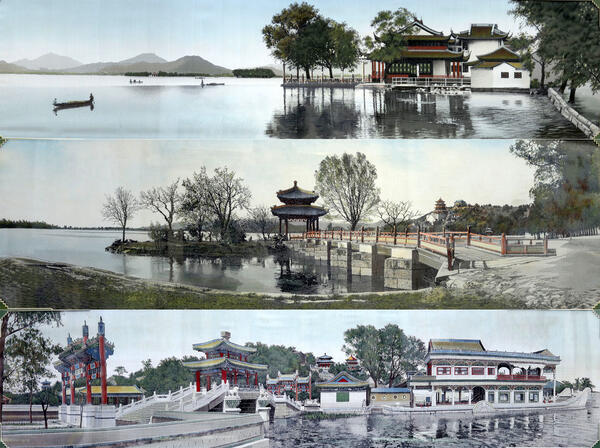
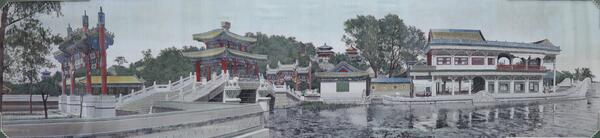
The panel is made in the technique of artistic embroidery on silk. It depicts a summer landscape, a view from the river to the shore. In the background is a city park with a green array of trees. To get there, you first need to go through the triumphal gate, then go up the stepped bridge, in the center of which is a double roof on four red pillars. Two sculptures of lions on large pedestals rise from the water to guard the passage over the bridge. Further steps lead to the gate, its canopy is decorated with carvings and paintings. To the right of the bridge is the bank, to which a small steamer with a high bow and wheel, moored low in the water. The deck of the steamer, with verandas and a roof, occupies two floors and is richly decorated with carvings and paintings. The bank of the river is built up with small houses, in the distance — the roofs of pagodas and a clear blue sky.

The silk embroidery, in which the landscape is made, perfectly conveys the play of light and shadow, because the silk thread has a triangular cross-section, which, like a prism, refracts light, which makes the colors shimmer. Silk embroidery is the traditional applied art of the Celestial Empire. It appeared 2000 years ago. The technique of Chinese embroidery is based on the use of untwisted silk thread. For the purpose the accuracy and preciseness of the stitch is necessary, which only the craftswomen with rich experience have. The ability of Chinese craftsmen to use all the possibilities of embroidery with silk thread is still appreciated all over the world.

For creation of even a small canvas, about 80 shades of thread are required, and for large works hundreds of them may be used. It is noteworthy that the threads are dyed individually for each silk item. Satin embroidery technique can reflect every stroke, every change in the tone of the picture, so silk, like no other material, is suitable for this art form, having flexibility, pliability and elasticity. Before starting work with threads, the quality of their coloring is being checked. The ornament is usually based on flower buds, plants, butterflies, birds, cats, tigers. The Chinese needlewomen create real masterpieces.

The panel ‘Cityscape’ was received by the Amur Regional Museum of Local Lore in 1958 from the Amur Province Executive Committee.
#1
Cityscape
#3
Scenery of Beijing Park
#4
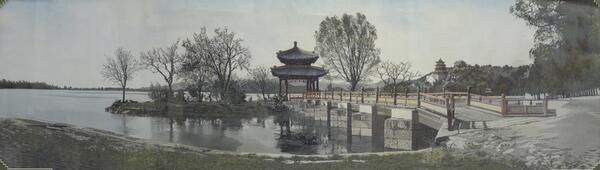
The panel is made in the technique of satin stich embroidery. It depicts a summer city landscape, in the center of which is a lake with an island connected to the shore by a stone bridge. On the island, there is a gazebo with a traditional Chinese figured roof on supports, trees and shrubs grow. On the right, on the shore, a pagoda and several buildings are barely visible. A red-railed bridge stands on massive stone bulls. On the left is the far shore of the lake with a strip of green. The water reflects the sky, dark tree trunks and the roof of the gazebo. The panel is fixed on a plywood backing under glass in a wide frame.

China is the first country in the world to use silk. According to legend, the wife of the emperor was drinking tea in the garden when a silkworm cocoon fell into her cup. In the hot drink, a thread stretched out of the cocoon, the length of which made it possible to walk around the palace. Since then, Empress Su Ling Chi, who discovered the secret of the silk thread, is considered a deity in China. Those who wanted to take the cocoons out of the country were executed as criminals.

In medieval France, Marquise de Pompadour introduced the fashion for silk bedding, and the Emperor Charlemagne raised the country’s economy by producing silk in Rouen and Lyon.

The making of silk thread and fabric led to the development of Chinese embroidery. This traditional applied art appeared in the country more than 2000 years ago. The embroidery technique is based on the use of non-twisted threads. At the same time, it is required to observe the accuracy and pinpoint precision of each stitch, such work is given only to craftswomen with solid experience. There are four main styles of Chinese silk embroidery, and they developed in different regions of the country based on local traditions. One of them is famous for its contrasts of black and white tones with transitions to gray shades, which gives the canvas a three-dimensional effect. The other is called “free stitch” and is characterized by its colors and stitches of different lengths and directions — such embroidery has received the highest recognition all over the world. For each silk panel, the threads were dyed separately.

Nowadays, Suzhou needlewomen are engaged in silk embroidery on an industrial scale, and their products are highly valued by tourists. In ancient times, such embroidery was available only to rich people. They were used to decorate the interiors of palaces and the clothes of the nobility. But time passed, and beautiful embroidered items came into the life of ordinary Chinese, filled with stories from fairy tales, myths, legends about beautiful women and kind dragons.

The panel was received by the Amur Regional Museum of Local Lore in 1958 from the Amur Regional Committee of the CPSU and the Regional Executive Committee.
#5
Panel
#6
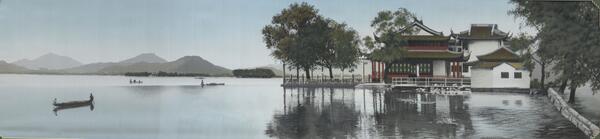
The panel is made in the technique of satin stich embroidery. The composition is framed in a passe-partout made of dark green cardboard and inserted into a frame under plexiglass.

In the foreground there is a lake, on the right side — the coast and part of the embankment. Among the tall green trees reflecting in the still water are several white buildings with traditional Chinese roofs. The largest house is brighter, with a red fence and veranda. Maybe there is a restaurant for vacationers. On the left on the lake are three fishing boats with figures of people. In the distance, against the background of a gray-blue sky, one can see the hills, wrapped in light fog.

In the culture of the Celestial Empire, embroidery is considered an important element — it is a part of human life. The technique of artistic embroidery on silk has its roots in ancient China, but since in the East people are very sensitive to the preservation of any traditions, we can see elements of ancient embroidery in the products of modern craftsmen.

In ancient times, embroidery was available only to wealthy people, it was applied to the clothes of the nobility, and framed the interiors of the imperial palaces. Even the wives of the rulers were engaged in needlework and devoted a lot of time and attention to this work. Many centuries passed, and embroidery became a part of the daily life of the Chinese, becoming an element of creativity — stories from legends and myths were added to it. During the Song Dynasty (960-1279), embroidery reached its peak.

The embroidery technique was constantly improving, the tools that the needlewomen used during their work were modified. It is worth noting that this is an extremely difficult craft that takes many days, because even a simple selection of materials can take more than one hour. It is necessary to choose the right shades and thickness of the threads to create realistic landscapes.

In China, this technique is inculcated from childhood, and all the subtleties of the master’s work are inherited. Perhaps the most popular and well-known Chinese embroidery technique in the world is the silk-on-silk method. This option really requires years of preparation. When creating silk paintings, more than a hundred different stitches and threads can be used, which are very close to each other, which creates a three-dimensional effect. The execution of double-sided paintings is considered the pinnacle of craftsmanship. The four embroidery schools located in different provinces are especially famous for this. Each has its own specific symbols, motives, uses different materials and paints.

The panel was received by the Amur Regional Museum of Local Lore in 1957 from the Amur Regional Committee of the CPSU and the Regional Executive Committee.
#8
read morehide
00:00
00:00
1x

Cityscape, Scenery of Beijing Park, Panel

Creation period
1957–1958
Place of сreation
China
Dimensions
159×39 cm, 47×137 cm
Technique
silk, threads; embroidery, damask stitching
0
Point your smartphone camera to open in the app
Share
VkontakteOdnoklassnikiTelegram
Share on my website
Copy linkCopied
Copy
Open in app
To see AR mode in action:
  1. Install ARTEFACT app for 
  2. iOS or Android;
  3. Find and download the «Paintings in Details» exhibition
  4. Push the «Augmented reality» button and point your phone's camera at the painting;
  5. Watch what happens on your phone screen whilst you flip through the pictures.
 
We use Cookies
Cookies on the Artefact Website. We use cookies to ensure that we give you the best experience on our website. If you continue without changing your settings, we'll assume that you are happy to receive all cookies on the Artefact website. However, if you would like to, you can change your cookie settings at any time.
Learn more about useHide
Content is available only in Russian

X

Нашли опечатку?...

%title%%type%