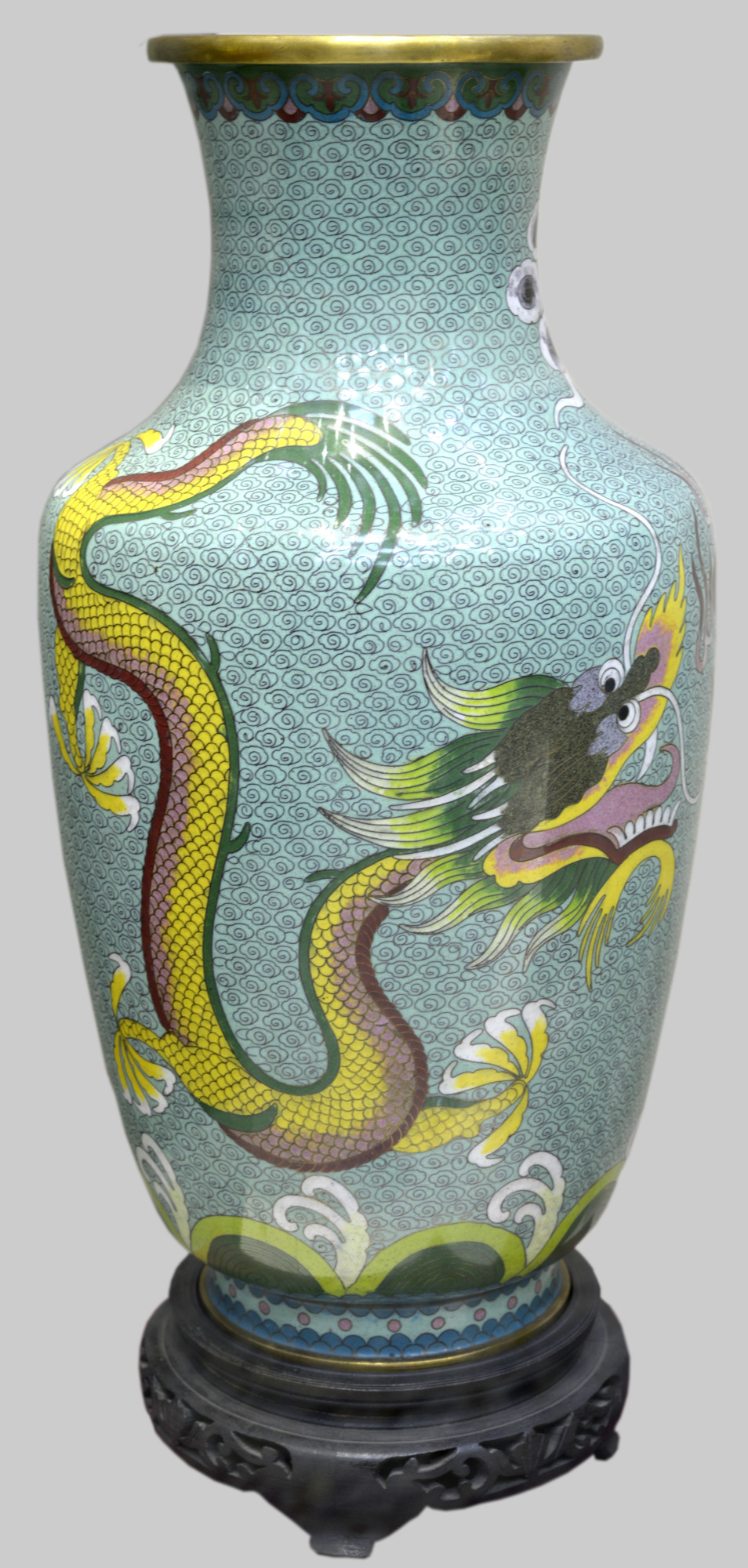


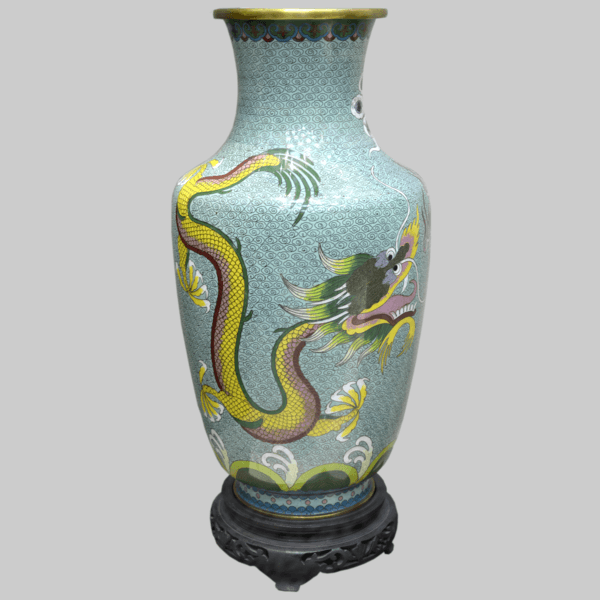
A green Chinese vase with a cylindrical body passing into a tapered throat with a polished rim bent outward. The stem is low, also conical, and ends with a copper rim from below. The surface is made using cloisonné enamel technique. Two yellow dragons are depicted on the vase’s body. The top of the throat and stem are decorated with floral and geometric ornaments. The base is blue, flat, with a small punctum. Enamel colors are shades of green, yellow, black, white, burgundy, blue and pink. The vase stands on a black openwork wooden stand.
The very name — “cloisonné enamel” — came from the French word “cloisonné” (“compartment” or “partition”). Indeed, the pattern is applied to the product using thin metal partitions, the gaps between them are filled with enamel, silvering or gilding is applied, then the product is fired and polished several times.
The art of cloisonné enamel originated in Ancient Egypt, with trade caravans it got to Byzantium and the Middle East. According to historians, this technique came to China from the Ottoman Empire and was perfected since the 15th century. The main color then was lapis lazuli. The craftsmen developed unique techniques, they were looking for new colors that would give a special beauty to glazed objects.
The most famous was the Beijing school of enamel production, since it was in the Forbidden City that the imperial palace was located. At that time, only the emperor and the nobility of the court had the right to own such items, which emphasized their special status. All production was strictly controlled by the state, and the products were sent to the treasury.
This technique was used to make famous Chinese screens, large floor vases, small vases, caskets, jewelry, and household items. The development of metallurgy provided the required amount of copper, which was used to create objects of various shapes, which led to a moonshot in production. In the 19th century, in the late period of the Qing dynasty, the technique of making cloisonné enamel gradually became more accessible, and individuals appeared who made less expensive items.
In the middle of the 19th century, cloisonné enamel items began to be exported to Europe, and the fashion for Chinese enamel spread throughout the world from France, the “trendsetter of elegant style”. Now the value of an item depends not on the technique, but on the artistic level, the age of the object, the master who created it.
It is assumed that the vase on a stand with the image of a yellow dragon was transferred to the Amur Regional Museum of Local Lore in the middle of the 20th century, when various Soviet-Chinese meetings began to be held in the city of Blagoveshchensk.
The very name — “cloisonné enamel” — came from the French word “cloisonné” (“compartment” or “partition”). Indeed, the pattern is applied to the product using thin metal partitions, the gaps between them are filled with enamel, silvering or gilding is applied, then the product is fired and polished several times.
The art of cloisonné enamel originated in Ancient Egypt, with trade caravans it got to Byzantium and the Middle East. According to historians, this technique came to China from the Ottoman Empire and was perfected since the 15th century. The main color then was lapis lazuli. The craftsmen developed unique techniques, they were looking for new colors that would give a special beauty to glazed objects.
The most famous was the Beijing school of enamel production, since it was in the Forbidden City that the imperial palace was located. At that time, only the emperor and the nobility of the court had the right to own such items, which emphasized their special status. All production was strictly controlled by the state, and the products were sent to the treasury.
This technique was used to make famous Chinese screens, large floor vases, small vases, caskets, jewelry, and household items. The development of metallurgy provided the required amount of copper, which was used to create objects of various shapes, which led to a moonshot in production. In the 19th century, in the late period of the Qing dynasty, the technique of making cloisonné enamel gradually became more accessible, and individuals appeared who made less expensive items.
In the middle of the 19th century, cloisonné enamel items began to be exported to Europe, and the fashion for Chinese enamel spread throughout the world from France, the “trendsetter of elegant style”. Now the value of an item depends not on the technique, but on the artistic level, the age of the object, the master who created it.
It is assumed that the vase on a stand with the image of a yellow dragon was transferred to the Amur Regional Museum of Local Lore in the middle of the 20th century, when various Soviet-Chinese meetings began to be held in the city of Blagoveshchensk.