

The Chinese have been moving to Manchurian lands since ancient times, bringing new customs, culture and clothing. At present, it is the northeastern lowland part of China with three provinces. Hence the flavor of the national costume of the inhabitants of this region.
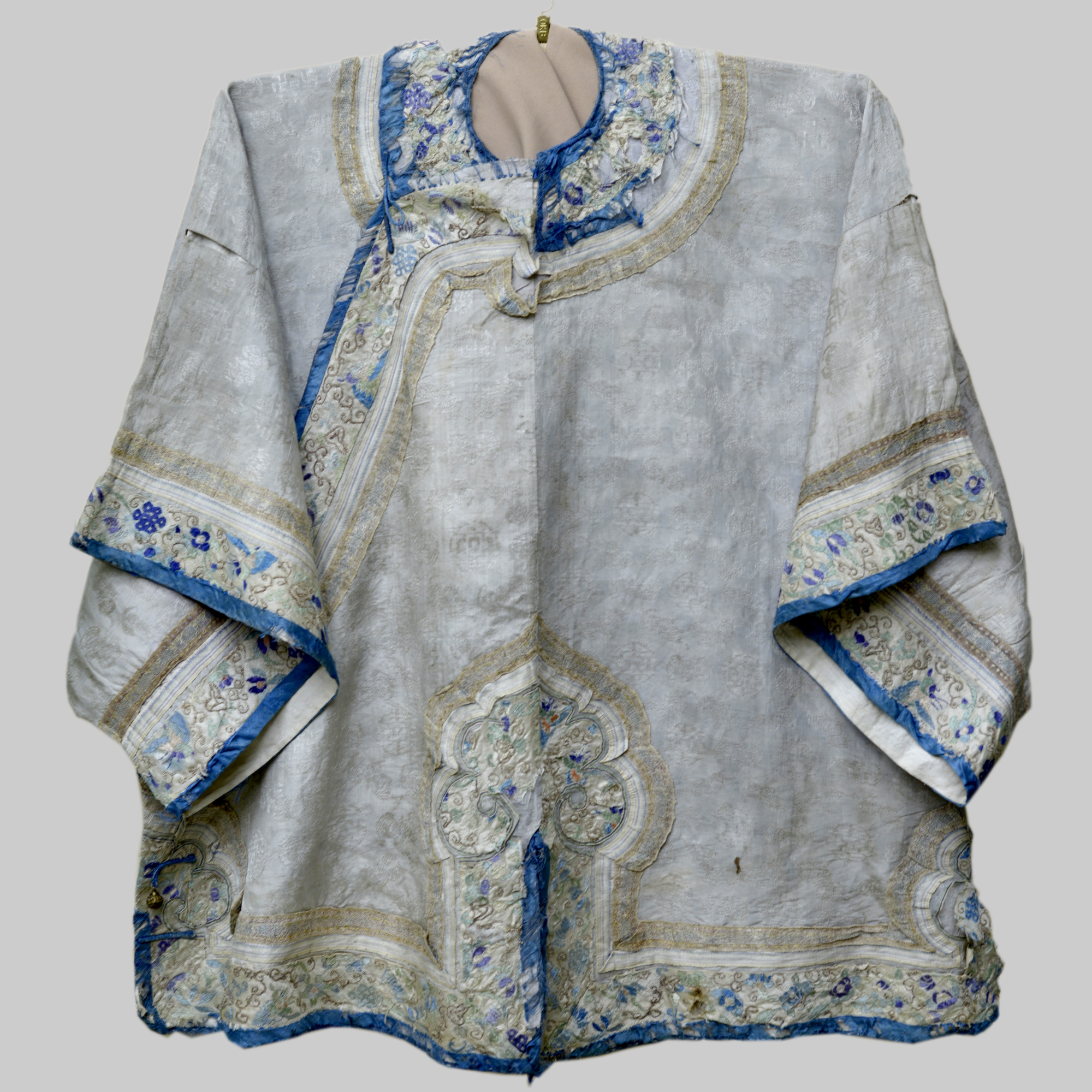
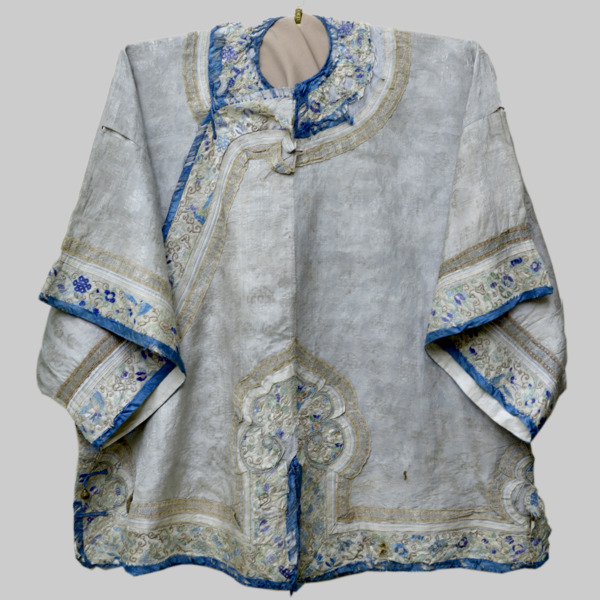
In front of us is a women’s blouse with a wrap of lilac silk. Along the fastener, collar, cuffs of sleeves and a hem, it is decorated with a lace of blue and light brown colors and stripes of silk fabric with colored national ornament. It has been preserved quite well; individual patterns can be seen on it. The sleeves of the blouse are one-piece, not very long, so they are much easier to sew. The fronts of the blouse create a wave-like wrap, the fastener has five metal buttons and air loops. In the front, in the lower part in the center, there is a 17 cm neckline decorated with embroidery. The neck is round, without a collar.
In the middle of the 18th century, during the era of Manchurian domination, in China, patterns of men’s and women’s clothing were established at the legislative level. They introduced civilian and military clothing for the emperor, representatives of the aristocracy, as well as officials of nine ranks: a special costume for ceremonies that were held at court; festive attire, which was chosen for less formal occasions; a suit for everyday wear, a travel suit and a dress worn in the rain.
For the highest dignitaries, outerwear was in the form of a jacket with insignia embroidered on it. If it was an emperor, then a five-fingered dragon was depicted on his clothes, which was a symbol of power. On the chest and back of the clothes worn by officials of the nine ranks, squares were embroidered with the image of certain symbols. Such squares were called ‘Mandarin squares’, they indicated the rank. The symbol of the first rank was a crane, the second was a golden pheasant, the third was a peacock, and so on. The symbols applied to civilian or military clothing were very different.
Women’s outfits were like men’s in their cut. They consisted of blouses and pants that reached the ankle, they were usually worn untucked. For sewing both things, a blue or colored paper fabric was taken. Women of the older generation usually opted for darker and more soothing colors, while young ladies preferred bright colors, mostly with floral patterns. Qipao, or long robe, is now the favorite dress of Chinese women, enthralling foreigners. Sometimes a wide jacket is worn over it, which is called a kurume, or a sleeveless jacket. The winter robe is made in the same style, but supplemented with cotton wool, like winter pants or a jacket.
The jacket was accepted for safe custody at the Amur Regional Museum of Local Lore in 1901. Unfortunately, the history of its admission didn’t preserve.
In front of us is a women’s blouse with a wrap of lilac silk. Along the fastener, collar, cuffs of sleeves and a hem, it is decorated with a lace of blue and light brown colors and stripes of silk fabric with colored national ornament. It has been preserved quite well; individual patterns can be seen on it. The sleeves of the blouse are one-piece, not very long, so they are much easier to sew. The fronts of the blouse create a wave-like wrap, the fastener has five metal buttons and air loops. In the front, in the lower part in the center, there is a 17 cm neckline decorated with embroidery. The neck is round, without a collar.
In the middle of the 18th century, during the era of Manchurian domination, in China, patterns of men’s and women’s clothing were established at the legislative level. They introduced civilian and military clothing for the emperor, representatives of the aristocracy, as well as officials of nine ranks: a special costume for ceremonies that were held at court; festive attire, which was chosen for less formal occasions; a suit for everyday wear, a travel suit and a dress worn in the rain.
For the highest dignitaries, outerwear was in the form of a jacket with insignia embroidered on it. If it was an emperor, then a five-fingered dragon was depicted on his clothes, which was a symbol of power. On the chest and back of the clothes worn by officials of the nine ranks, squares were embroidered with the image of certain symbols. Such squares were called ‘Mandarin squares’, they indicated the rank. The symbol of the first rank was a crane, the second was a golden pheasant, the third was a peacock, and so on. The symbols applied to civilian or military clothing were very different.
Women’s outfits were like men’s in their cut. They consisted of blouses and pants that reached the ankle, they were usually worn untucked. For sewing both things, a blue or colored paper fabric was taken. Women of the older generation usually opted for darker and more soothing colors, while young ladies preferred bright colors, mostly with floral patterns. Qipao, or long robe, is now the favorite dress of Chinese women, enthralling foreigners. Sometimes a wide jacket is worn over it, which is called a kurume, or a sleeveless jacket. The winter robe is made in the same style, but supplemented with cotton wool, like winter pants or a jacket.
The jacket was accepted for safe custody at the Amur Regional Museum of Local Lore in 1901. Unfortunately, the history of its admission didn’t preserve.