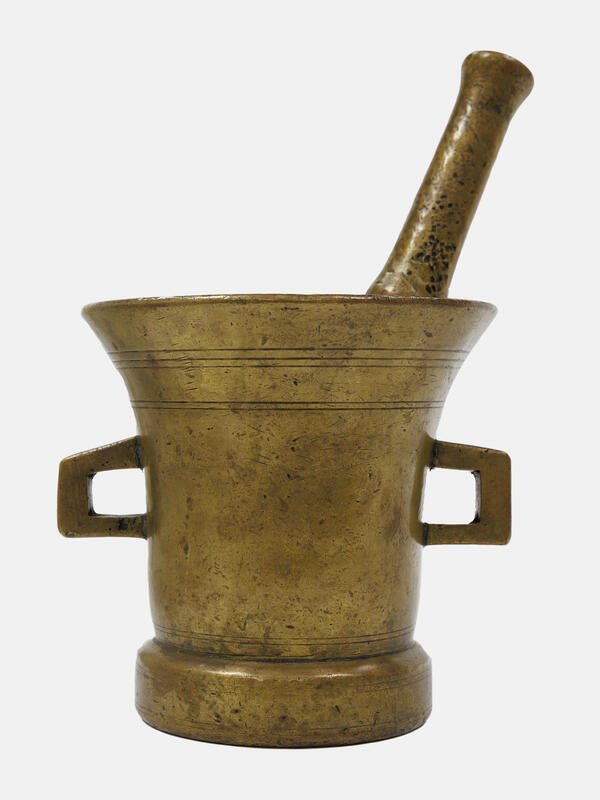
The exhibition houses a mortar in the shape of a truncated cone flaring at the top and standing on a wide base. The pestle is solid, made of a copper-based alloy. Legend has it that these items belonged to the Chekhov family between the 1930s and the 1960s. They were donated to the museum by the widow of Sergey Chekhov, the writer’s nephew.
The mortar is an ancient tool used for crushing and grinding various ingredients, including salt, pepper, nuts, garlic, poppy seeds, and herbs. Small kitchen mortars are used for grinding coffee beans, making powdered sugar, crushing large salt crystals, and preparing sauces. Russian wooden potato mashers were also based on a principle similar to the mortar and pestle.
Pestles of various sizes and shapes can be chosen depending on the properties of the product — the particle size and hardness, as well as the desired texture. There are two kinds of pestles: the ones with a rounded working surface are used for grinding the ingredients, and the ones with a flat surface are only suitable for crushing. Often, one pestle has two different ends. Anton Chekhov mentioned a mortar and pestle in his short story “The Shoemaker and the Devil”,