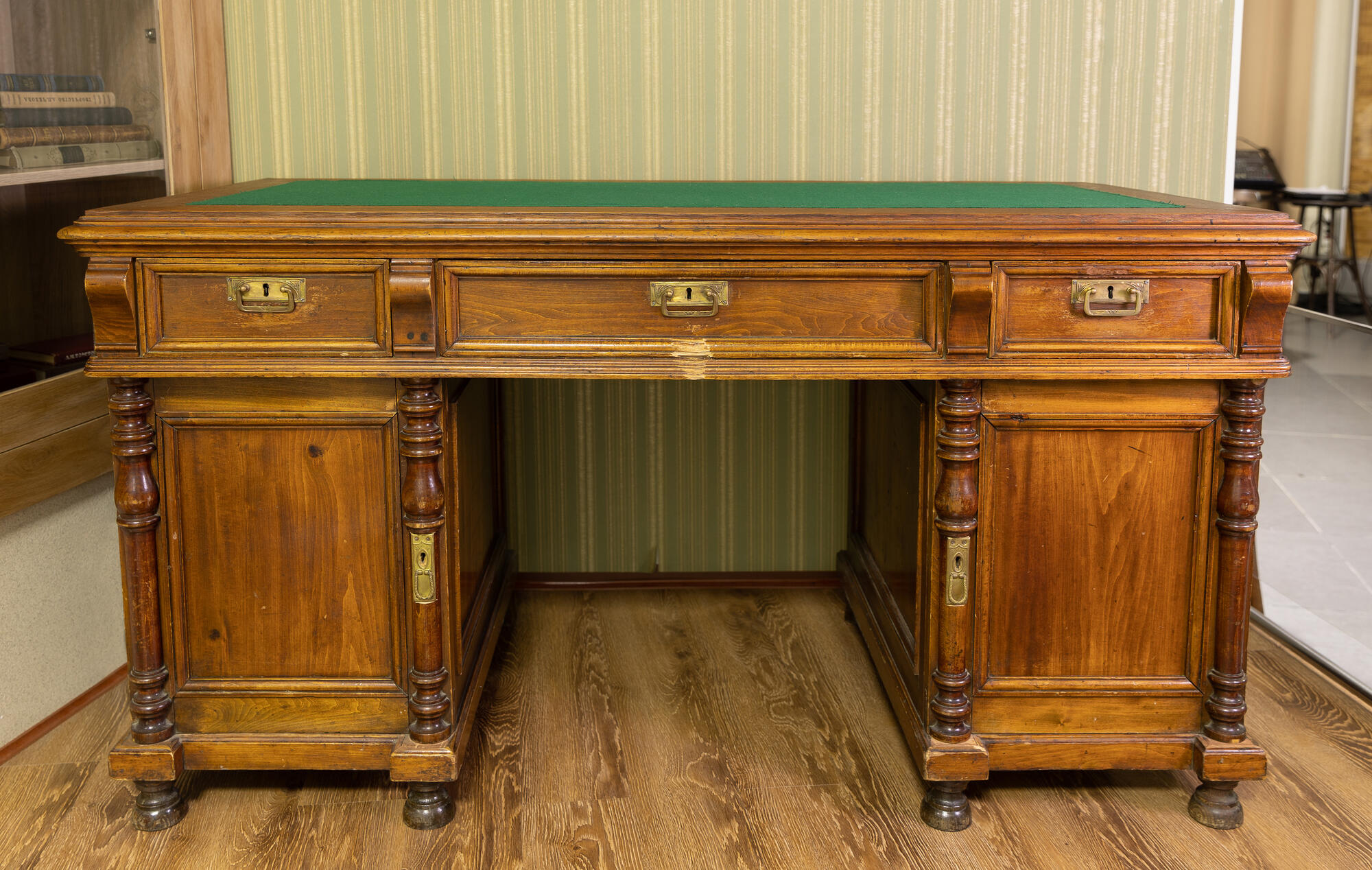


The museum houses a wooden desk with cabinets on both sides and a work surface covered with green cloth. The desk has three drawers: two above the cabinets and one in the center. Both the drawers and the cabinets can be locked. A blue stamp has been preserved on the central drawer that reads, “Rostov Factory”. The museum purchased this desk in 2014 to expand its collection of “Applied Arts and Household Items”.
The late 19th-century furniture was distinguished by its simplicity and minimalistic design. It was carved out of various types of wood, including walnut, birch, poplar, aspen, and ash, but was often painted to look like mahogany which was fashionable at the time. Shades ranged from yellowish red to dark crimson. The main method of finishing was careful polishing which emphasized the natural beauty of wood. Furniture was rarely decorated with carving, gilding, or patterns, which was in line with the standards of the strict classic style.
The first desks with two cabinets and a knee hole appeared in Europe in the late 17th century. Originally, the side drawers of such writing bureaus were placed under the top and fixed to the high carved or chiseled legs. A century later, the drawers started taking up the entire place between the floor and the tabletop. In the 19th century, the top began to be covered with cloth, leather, or leatherette, and the drawers were hidden in cabinets with lockable doors. Such desks were placed in studies.
A study as a separate private area for rest and work appeared by the beginning of the 19th century. It usually featured large bookcases and a sofa for relaxing. The central place was taken by a massive two cabinet desk of the study’s owner. Anton Chekhov had his first study only at the age of 26, when his short stories started bringing in enough money to rent a two-story apartment in Moscow for his family.
The furnishings of the writer’s study were always modest, but at the same time reflective of his personality. In his studies, Anton Chekhov kept the things that were of sentimental value to him, including paintings by his friend Isaac Levitan and his brother Nikolay Chekhov, signed photos of Dmitry Grigorovich and Pyotr Tchaikovsky, dragon-shaped candlesticks, and souvenirs from European trips.