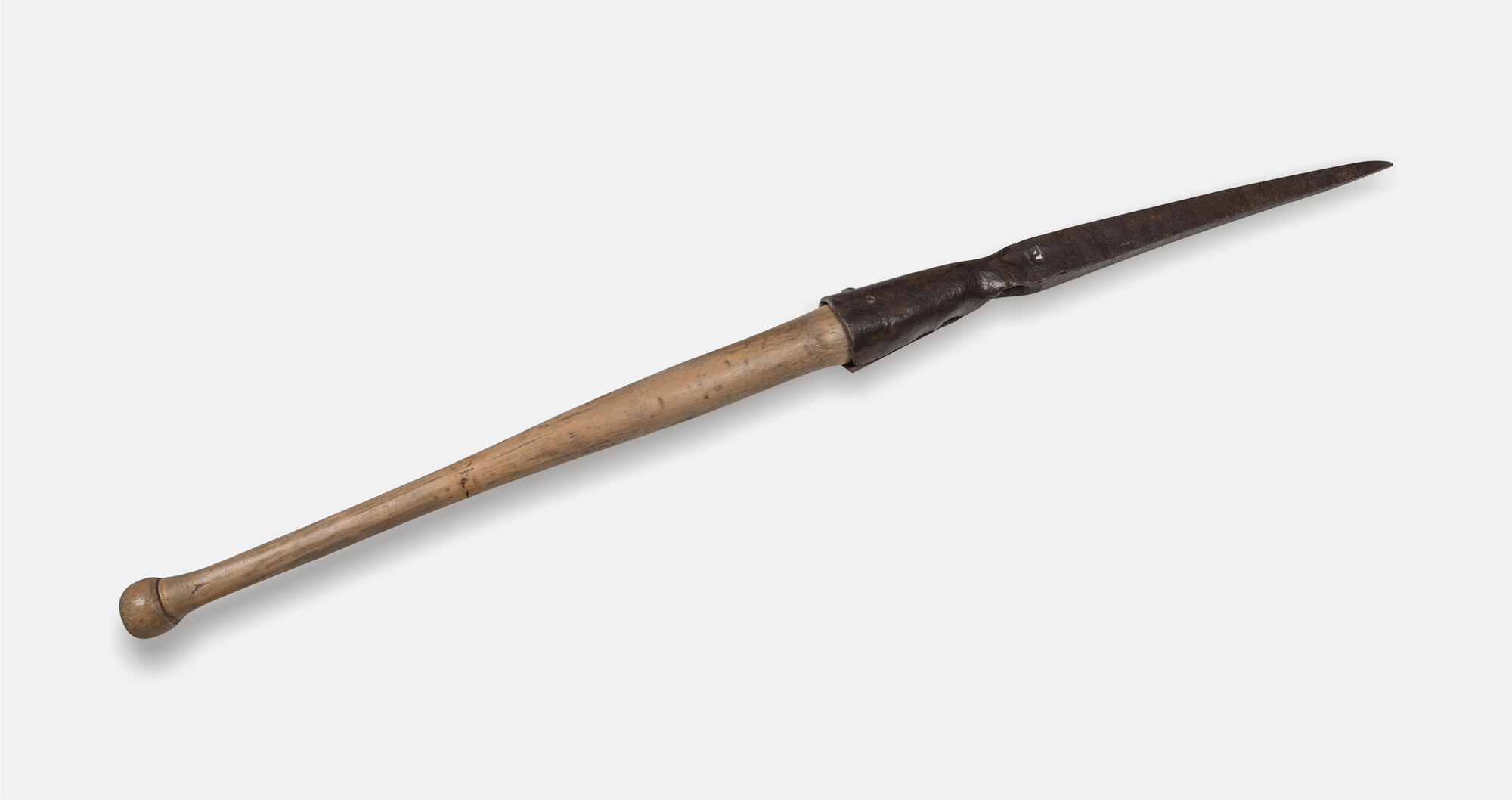


An ice chisel is a traditional tool used for cutting holes in the ice and testing the strength of ice. It combines the functions of a long pole with a metal spike and an axe with a short handle.
In winter, the inhabitants of the shores of the Curonian Lagoon always brought an ice chisel in their sled: the lagoon would freeze but fishing never stopped. That is why the method of fishing under the ice became widespread: metal chisels with wooden handles were used to make holes in the ice. The chisel was also used to test the strength of the ice. If the ice survived three powerful blows, it usually indicated that the ice was strong enough to support the weight — and that winter fishing could begin. The ice chisel is used to check the edges of a crevasse in the ice and to clean it if necessary. The ice chisel was used to break ice blocks and place them into a crevasse so that it would be safer to cross. Finally, the tool could be used to prevent the so-called “slingshot effect”. When traveling on a smooth ice surface, the sled would slide sideways, because the friction between the runners and the ice surface was too weak to keep the sled moving in a straight line. If the rider lost focus and did not immediately pull the reins to the side to prevent the sleigh from sliding sideway, the sled would begin to circle around the horse as the pivotal point and would rotate so fast that the passengers would fall out of it as if from a slingshot. This could be prevented by driving an ice chisel into the ice. This would slow down the sideways movement.
In Russian, the ice chisel was known as the
“ledorub” or “peshnya”. According to archaeological findings, the ice chisel
has been known since ancient times. It was attached to a strong 1.5-meter-long
stick, with a string tied to its end and wrapped around the hand, so that the
ice chisel could not sink in the ice hole in the case of being dropped. Workers
who made holes in the ice to spread the net were called “pekhoryas”.