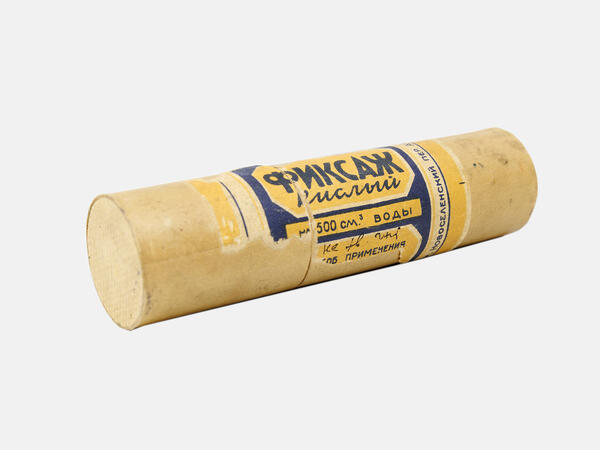
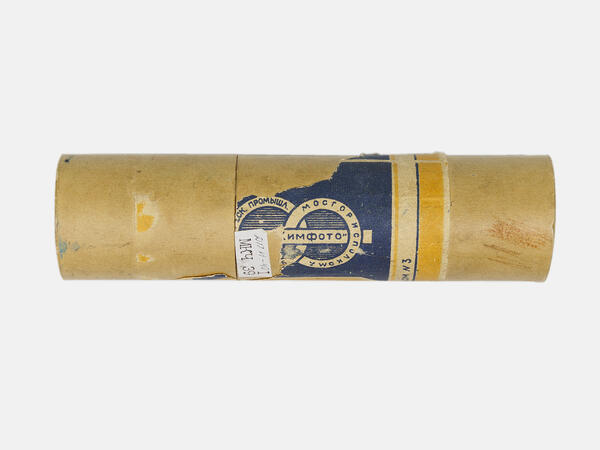
This cardboard tube with a lid belonged to the family of Anton Chekhov’s younger brother Mikhail and was donated to the museum in 1995. There is a printed inscription that reads, “Acid fixer, colored paper”. The word “sanguine” is also written in ink which refers to a chalk stick used for drawing. Perhaps, the tube was used not only for photography supplies but also for the painter’s tools.
A fixer is an aqueous solution, a mix of chemicals that remove the silver halide remaining on the photographic film or paper. This chemical solution is used after the film in a camera is finished. It is then removed from the camera, wound onto a reel, and placed in a tank where the developer is poured. The film is soaked for several minutes to produce an image. The entire process takes place in complete darkness to avoid exposing the film to light.
The use of the developer was followed by a rinse with clean water or a stop bath containing a dilute solution of acid. At this stage, the action of the developer was halted by the removal of excess components from the photographic layer.
If the processed photographic materials are intended for prolonged storage, it is recommended to use a stop bath — a solution of sodium carbonate or sodium hydrogen carbonate — or apply solutions of thiosulphate-destroying substances — hydrogen peroxide with ammonia. A stop bath also contains potassium or sodium metabisulfite or bisulfite. Such a fixer quickly halts the action of the developer brought in with the photographic layer because the alkaline components of the developer are neutralized in an acidic environment.
The first photographic experiments date back to the mid-19th century and are closely connected with scientists studying the physical properties of light and chemical elements. They sought to capture the image visible to the eye and transfer it onto some surface. As a result of research and experimentation, the first photo camera and film were created. Photographic processing of the film after taking the picture remained the most difficult task, which depended a great deal on the photographer’s expertise in chemistry.