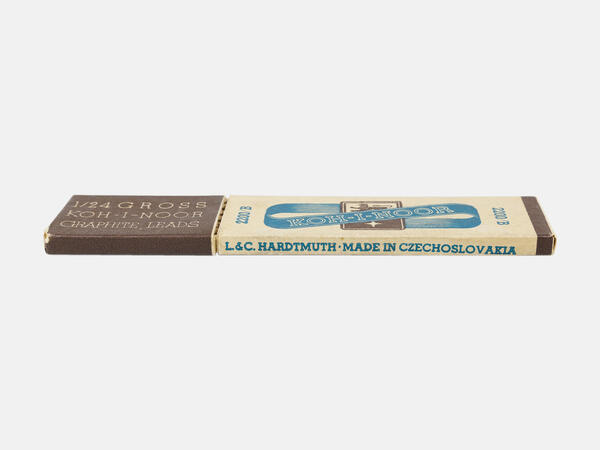
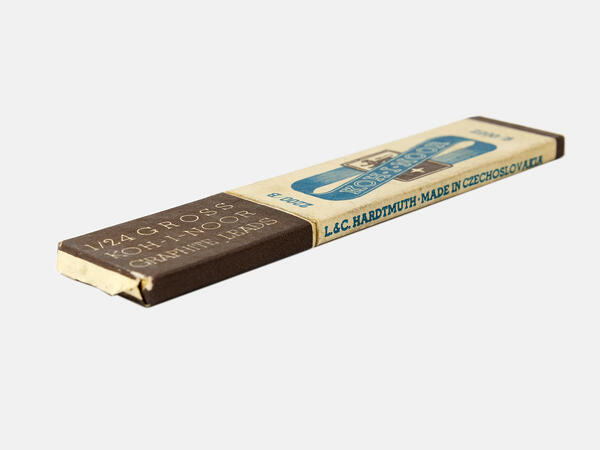
This cardboard box with graphite leads for a mechanical pencil belonged to the family of Anton Chekhov’s nephew. Sergey Mikhailovich Chekhov and his son Sergey Sergeyevich were both artists, working on paintings, drawings, and illustrations. They created hundreds of works dedicated to the life and writings of their famous relative.
Pencils are classified into lead and colored, hard and soft, disposable and reusable. Colored pencils based on natural pigments and wax appeared in antiquity, and the prototype of a modern lead pencil was developed in the 13th century.
Medieval artists drew using a silver wire which was soldered to a handle. This technique was known as silverpoint. It was famously used by the German printmaker Albrecht Dürer. Over time, the marks of silverpoint tarnished to a brown tone.
Another drawing implement was black chalk, also known as an Italian pencil. It was made of black shales, and later of glued bone char. Graphite pencils appeared in the 15th century when large deposits of the new material were discovered in England after a hurricane. Graphite was soft and stained hands easily, which is why it was carried by wrapping it in paper or tying it between two sticks.
A series of experiments by German scientists resulted in the development of a modern pencil in the 18th century. The price of graphite increased greatly because of its military importance. In 1790, the Austrian ceramist Joseph Hardtmuth invented and patented a rod that was made by mixing powdered graphite with clay and then firing it in a kiln.
Hardtmuth came up with a method of varying the hardness of the graphite rod and his factory became the leader of pencil production. The inspiration for the company’s name was the Koh-i-Noor diamond, one of the world’s most famous gemstones. Its name literally means “Mountain of Light”.
One hundred years later, the American inventor Alonzo Cross designed a mechanical pencil that did not require sharpening. It is also known as a clutch pencil because of the metal clutches that hold the lead and are adjusted using a button at the opposite end.