This pencil case belonged to the Chekhov family and was donated to the museum in 1995. The writer’s nephews were artists. A lot of their stationery has been preserved which dates back to the turn of the 20th century and the Soviet period.
In pre-revolutionary Russia, pencil cases were made in the form of boxes with several compartments. Such a pencil case is described in detail in Valentin Katayev’s book “A White Sail Gleams”, where the main character’s parents buy him writing materials,


Wooden pencil case with a sliding lid
Creation period
the 19th century
Place of сreation
the Russian Empire
Dimensions
12,5x5,7x2,4 cm
Technique
wood, glue, nails; grooving, stamping, factory production
Exhibition
0
Open in app#5
#6
Then they had chosen a wonderful pencil case with a transfer picture on its sliding lacquered top. The top fit so tightly that when it was opened it squeaked like a wooden peasant toy-box. Petya put a great deal of care and taste into filling all the sections of the case with the proper articles, making a point of it that none remained empty.
#7
The writer also described the contents of the pencil case. “All kinds of nibs went into the case… Then there was a rubber with an elephant drawn on it, a crayon, two pencils, one for writing and the other for drawing, a penknife with a mother-of-pearl handle, an expensive pen (it cost 20 kopecks), and colored pasting tabs, drawing pins, pins, and pictures.”
Wooden pencil cases were popular in the Soviet Union until they were replaced by plastic ones. Pencil cases had retractable lids, which were sometimes marked so that they could be used as rulers. Inside, there were usually two or three compartments, one for pencils and brushes, one for a fountain pen, and one for an eraser.
Students carried their spill-proof inkwells separately, often in a special pouch. Pencil cases were not very diverse — in the paintings made by artists from various countries in the early 20th century, all such cases look almost the same.
In the late 1980s and early 1990s, soft pencil
cases came into fashion. Nowadays, pencil cases come in many shapes and sizes.
There are tube cases, rectangular pencil cases with a rigid shell encasing and
rubber bands for fixing pens and pencils, metal and plastic ones, and pencil
pouches made of fabric and other soft materials. They are used for keeping
pens, pencils, sharpeners, erasers, rulers, marker pens, scissors, glue, and
other stationery. Any pencil case should be practical, functional, and durable,
designed for daily use.
#9
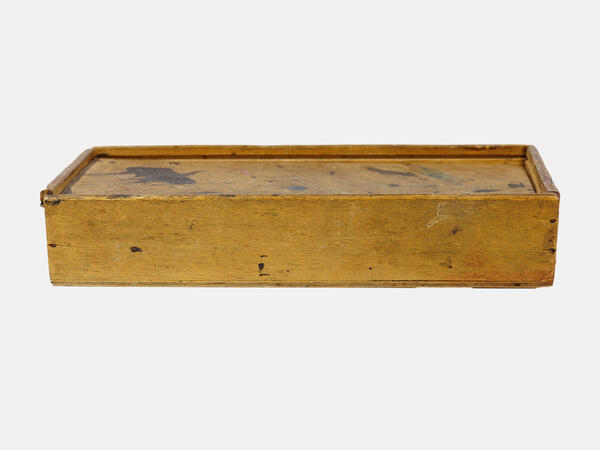
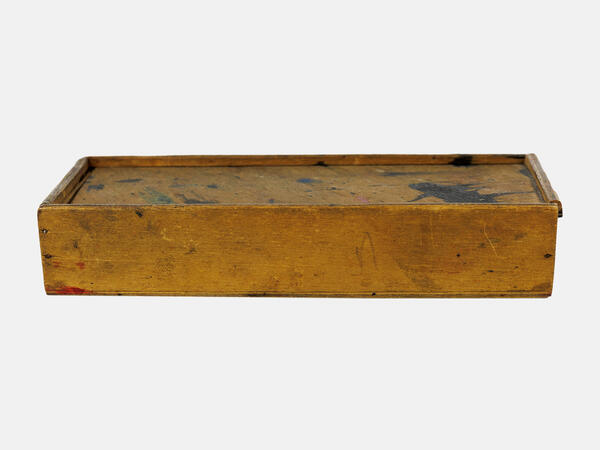
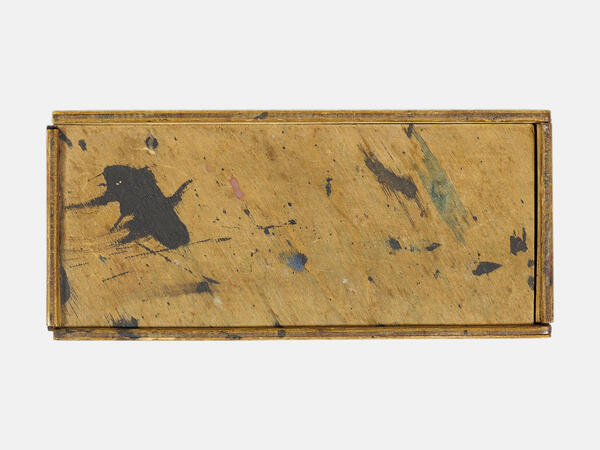
Wooden pencil case with a sliding lid
#8
Ministry of Culture of the Russian Federation
read morehide
00:00
00:00
1x
Wooden pencil case with a sliding lid
Creation period
the 19th century
Place of сreation
the Russian Empire
Dimensions
12,5x5,7x2,4 cm
Technique
wood, glue, nails; grooving, stamping, factory production
Exhibition
0
 Point your smartphone camera to open in the app
Open in app
Share

