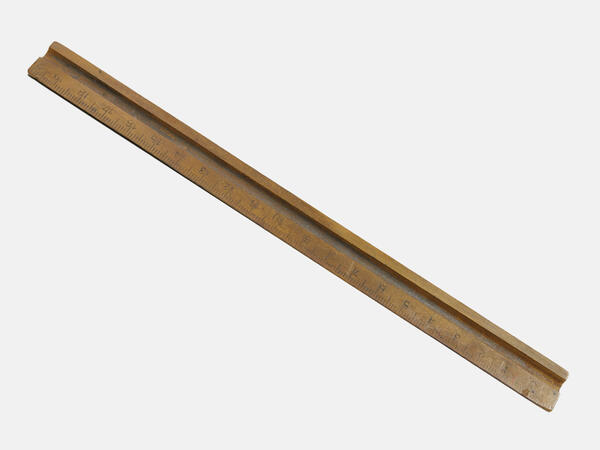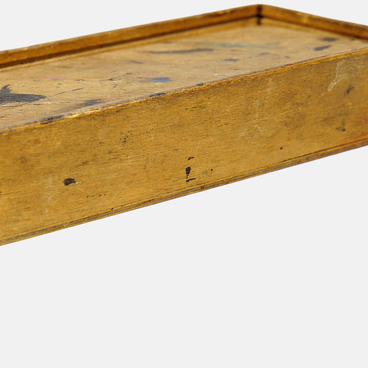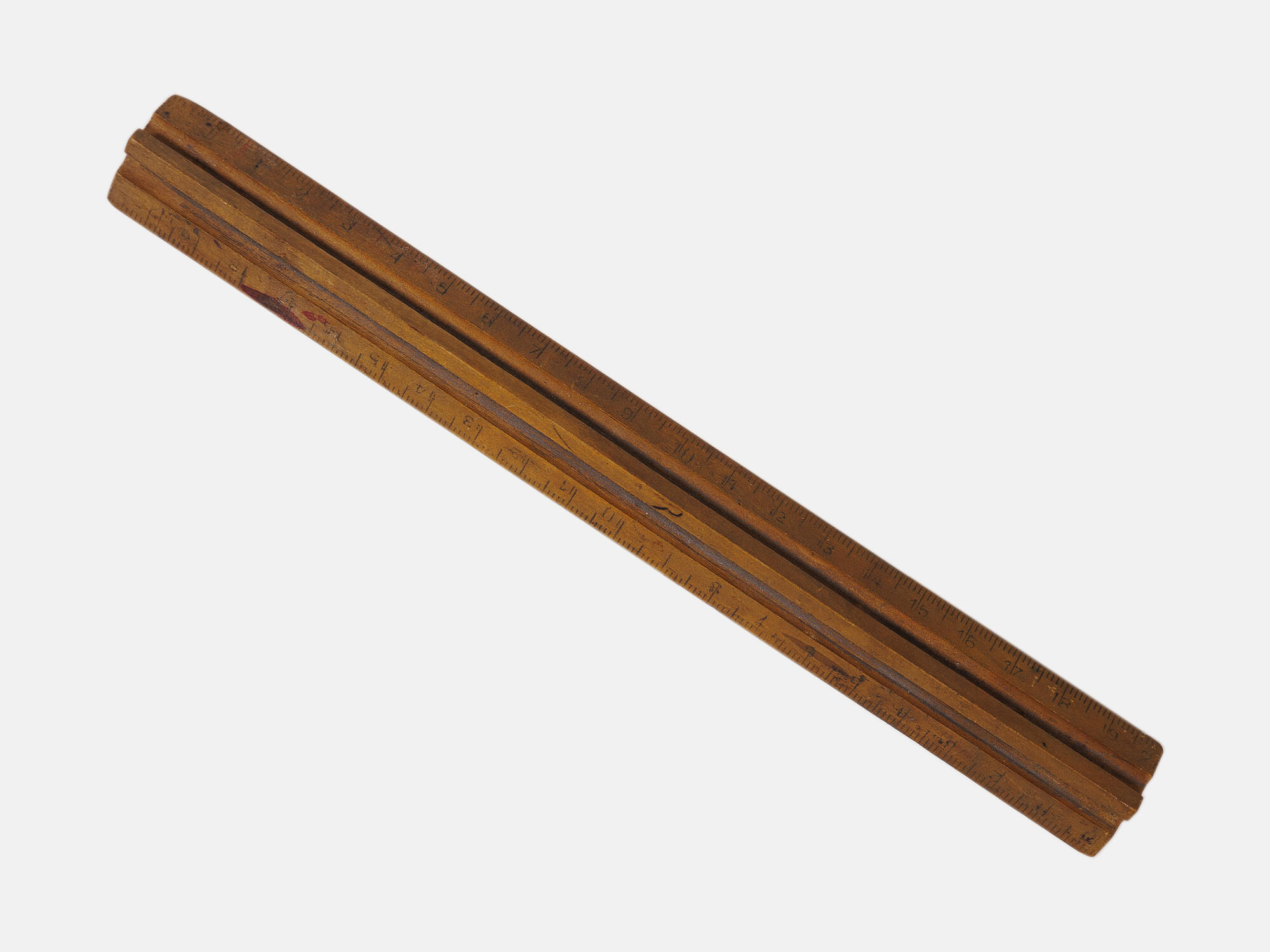


This wooden three-sided ruler is believed to have belonged to the Chekhov family. It was donated to the museum by Valentina Chekhova, the widow of Sergey Chekhov. The writer’s nephew and grandnephew were both artists, working on paintings, drawings, and illustrations, which is why there was always a lot of stationery at their place. This ruler has two grooves and a scale from zero to twenty centimeters.
A ruler is the simplest measuring instrument, which appeared more than two and a half thousand years ago. The first rulers were made of rods, chiseled wooden planks, and ivory. Before a uniform system was developed, representatives of different civilizations established their own standard measures marked by drawings, symbols, and hieroglyphs. Traditional units of measurement reflected common and easily understandable notions: length and distances were measured by paces, elbows, and fingers, volume — by cups and buckets, and mass — by gold coins and grains.
The unified metric system was developed over 200 years ago, during the French Revolution. The length of a meter was calculated as one ten-millionth of the length of the meridian arc on the Earth’s surface from the Equator to the North Pole through Paris. The international community did not agree upon this definition at once because each country wanted to use the meridian passing through its capital. The uniform metric system was finally accepted worldwide only in the second half of the 20th century.
A meter was divided into centimeters and millimeters, which were also marked on uniform rulers. At first, metric rulers were the privilege of academicians and architects, but soon they became widespread among school and university students.
This ruler was brought to the Russian Empire after the Patriotic War of 1812 as a war trophy from France. The chemist Dmitri Mendeleev initiated the introduction of the metric system in the Russian Empire and the production of rulers in 1899, but the new system was not officially adopted until the Russian Revolution of 1917.
Nowadays, a ruler is a basic stationery item that
is made of plastic, wood, or metal. Folding rulers can be handy during
expeditions and short rulers are convenient to store. Tailors and dressmakers
use a flexible measuring tape, or a tailor’s tape, while construction workers
often need a tape measure.