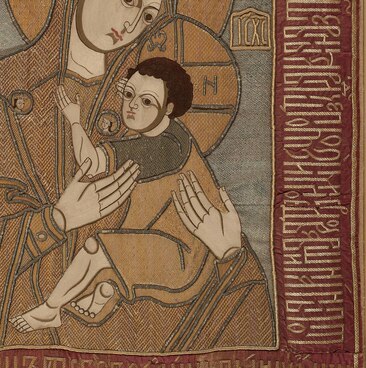
The podea “Saint Christopher” was manufactured by the gold embroidery workshop of Anna Ivanovna Stroganova, née Zlobina, wife of the famous Dmitry Andreyevich Stroganov. Her activity marked the heyday of the Stroganov pictorial embroidery. All researchers who studied the art of the Stroganov workshops described this time as the most fruitful period in their history.
St. Christopher is one of the earliest and most unusual Christian saints. Most often, he was depicted with the head of a dog.
The “Saint Christopher” podea has an interesting story behind it. At first, Christopher was depicted with a dog’s head. Traces of the original image can clearly be seen on the podea. Later, however, the dog’s head was changed to a human head.
The saint is depicted standing in prayer before the Virgin Mary Who is holding the Christ Child. Their images are embroidered in the cloudy segment in the upper left corner of the centerpiece. Christ blesses the saint. In front of Christopher, lie his weapons: the sword, bow, and quiver with arrows.
The faces, hands, and other exposed parts of the body of St. Christopher, the Virgin Mary, and the Child, are traditionally embroidered with pearl-gray densely twisted silk threads. The facial features are sketched using grayish-brown silk threads. The contours of the figures and folds of clothes are highlighted with silver thread in relief, using the so-called “rope stitch”.
The background, clothes, and other details of the composition are embroidered with spun gold and silver threads using the couching technique. The silk couching threads form geometric patterns which are typical of the Stroganov pictorial embroidery.
The clouds and earth are made using the filigree technique. A large flower is embroidered with gold threads in the background of the centerpiece under the Virgin Mary.
The borders of the podea
are sewn from red satin; red taffeta is used for the lining. The borders
feature a silver-thread inscription with the troparion to the saint, “Your
martyr Christopher has suffered martyrdom…” At the bottom of the podea, there
is another inscription made with silver threads,