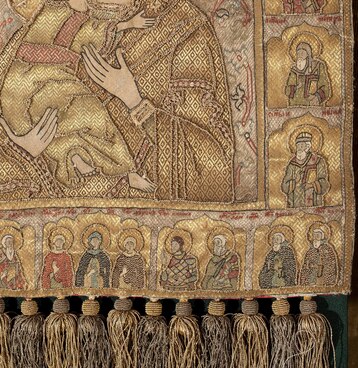
The podea “Our Lady of the Way” was manufactured by the workshop of Anna Ivanovna Stroganova, née Zlobina, wife of Dmitry Andreyevich Stroganov. The exhibit is an amazingly beautiful and representative artwork. The image is so expressive and exquisite that at first glance it can be difficult to identify that this is embroidery.
The silhouette of the Virgin Mary with the Child harmoniously fits into the pictorial space of the podea. The combination of the delicate and exquisite drawing with stillness, as well as a masterful composition, great technique, and precise choice of contrasting colors create a majestic item.
The image’s iconography is actually closer to the icon “Of the Passion”. The main differences are that there are no angels and Christ is supported by Mary’s left arm. He faces not the angels but the viewer, and the sole of His uncovered foot can be seen. Three medallions with the faces of angels are depicted on the omophorion — the upper garment worn by the Virgin Mary around Her shoulders and head. These faces can be interpreted either as the Holy Trinity or as a symbol of virginity.
In the Siya Icon Painter’s Guide, this type of icon is called “What Shall We Call You?”, after the first words of the hymn that is written along the edge of Mary’s omophorion. Its following lines reveal the meaning of the image, “Virgin, for You have remained undefiled? Pure Mother, for You have held in Your holy embrace Your Son, God of all?”
The image is characterized by a narrow silhouette. The Virgin Mary is depicted with a small head, narrow eyes, a thin, slightly hooked and pointed nose, and tight thin lips. The face, hands, and other exposed parts of the body of the Virgin Mary and Christ Child are embroidered with densely twisted silk threads of light gray with schematic darker shadows. The clothes, background, and other details of the composition are sewn with spun gold and silver threads using the couching technique. Colorful silk couching threads form traditional geometric patterns. The contours, folds of clothes, and inscriptions in the centerpiece are made with silver thread using the so-called “rope stitch”. Red satin is used for the border.
At the bottom of the podea,
there is an embroidered inscription in a frame,