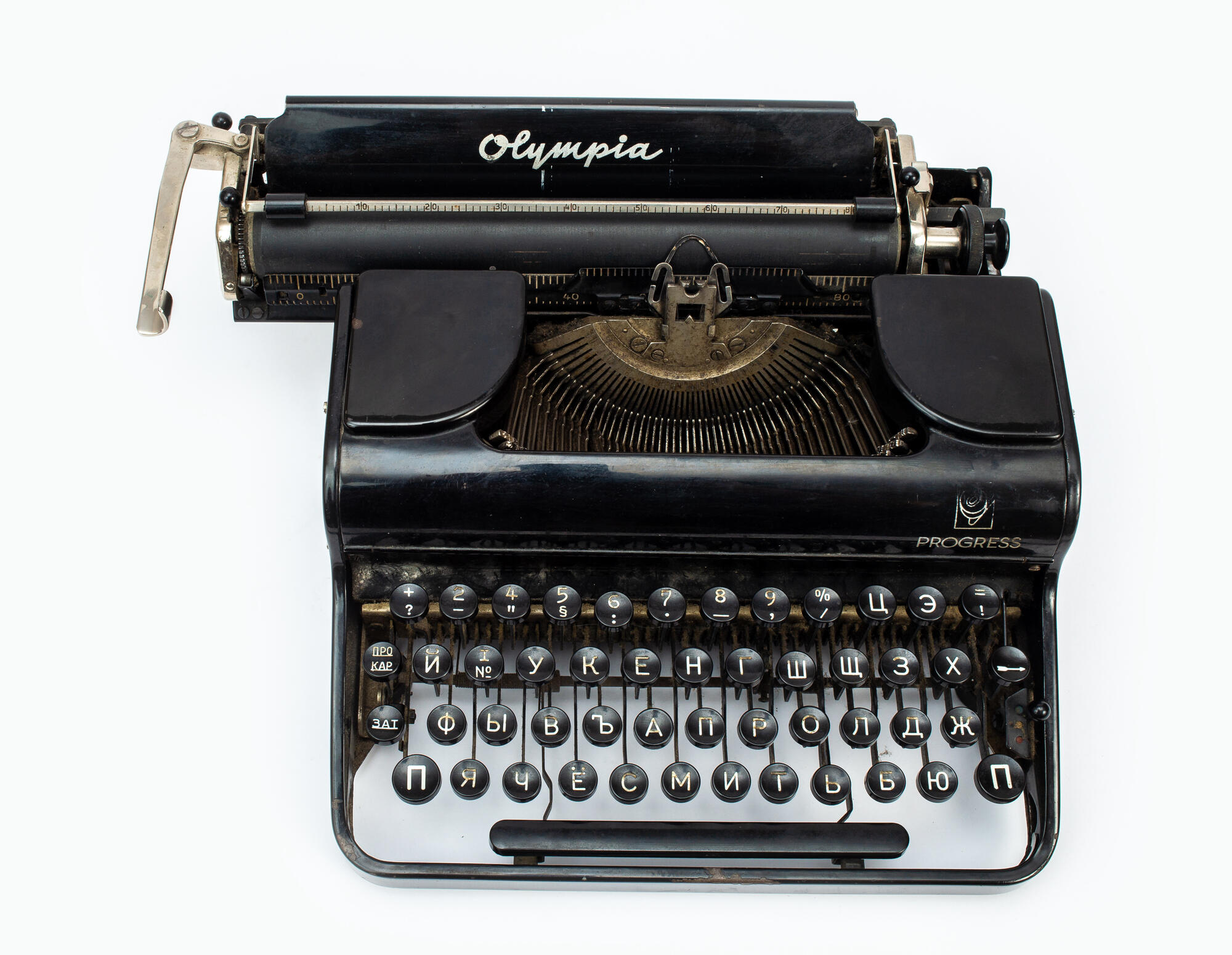


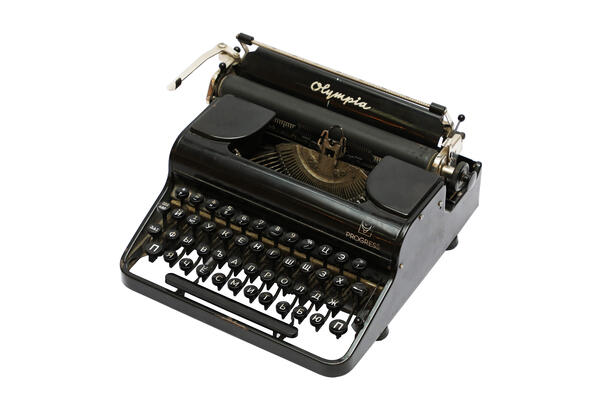
The collection of the Verkhnyaya Pyshma Historical Museum houses an Olympia typewriter. These devices were produced in Germany since 1930. The release of this model was timed to coincide with the Summer Olympic Games, which were held in Berlin in 1936 — hence the name of the model.
The company that produced Olympia typewriters appeared in Berlin in 1903. Its name AEG stands for ‘Allgemeine Elektricitäts Gesellschaft’, translated as ‘Universal Electric Company’.
In 1912, AEG produced the first classic typewriter with an alphabetic keyboard. The model was experimental; it was encased in bronze. By the beginning of 1914, the engineers had all the necessary units assembled, and the plant started the production.
When World War I broke out in July 1914, the AEG plant was converted for military needs and began to produce weapons. Typewriters were still produced, but in small quantities — about 150 machines per year. The large-scale production could be restored only in 1921. Two years later, the company expanded and moved from Berlin to Erfurt, a city in central Germany.
In 1930, the AEG plant changed its name to ‘Europa Schreibmaschinen AG Berlin — Erfurt’ (‘European typewriters AG Berlin — Erfurt’). All typewriters began to be called ‘Olympia’. Finally, in the year of the Olympics, the company was renamed again: it became known as ‘Olympia Büromaschinenwerke AG’ (‘Olympia Stationery Typewriters’).
In the 1930s, the plant produced several models of Olympia machines: Progress, Simplex, Robust, Elite, Filia, Plana — they varied in size and functions.
In April 1945, American troops occupied Erfurt and the surrounding area, and the factory building was seriously damaged. After the war, the enterprise was in the Soviet occupation zone — subordinate to the Soviet military administration in Germany, and the plant in Erfurt reported to the Vladimir machine-building enterprise ‘Tochmash’. The production of cars was resumed as soon as July 1945, and in August the plant began to supply Olympia typewriters to the USSR as war reparations — payment for the war costs.
The company that produced Olympia typewriters appeared in Berlin in 1903. Its name AEG stands for ‘Allgemeine Elektricitäts Gesellschaft’, translated as ‘Universal Electric Company’.
In 1912, AEG produced the first classic typewriter with an alphabetic keyboard. The model was experimental; it was encased in bronze. By the beginning of 1914, the engineers had all the necessary units assembled, and the plant started the production.
When World War I broke out in July 1914, the AEG plant was converted for military needs and began to produce weapons. Typewriters were still produced, but in small quantities — about 150 machines per year. The large-scale production could be restored only in 1921. Two years later, the company expanded and moved from Berlin to Erfurt, a city in central Germany.
In 1930, the AEG plant changed its name to ‘Europa Schreibmaschinen AG Berlin — Erfurt’ (‘European typewriters AG Berlin — Erfurt’). All typewriters began to be called ‘Olympia’. Finally, in the year of the Olympics, the company was renamed again: it became known as ‘Olympia Büromaschinenwerke AG’ (‘Olympia Stationery Typewriters’).
In the 1930s, the plant produced several models of Olympia machines: Progress, Simplex, Robust, Elite, Filia, Plana — they varied in size and functions.
In April 1945, American troops occupied Erfurt and the surrounding area, and the factory building was seriously damaged. After the war, the enterprise was in the Soviet occupation zone — subordinate to the Soviet military administration in Germany, and the plant in Erfurt reported to the Vladimir machine-building enterprise ‘Tochmash’. The production of cars was resumed as soon as July 1945, and in August the plant began to supply Olympia typewriters to the USSR as war reparations — payment for the war costs.