Verkhnyaya Pyshma is called the ‘copper capital of the Urals’ — copper has been mined here since 1854. The main enterprise in the region was the Pyshminsky Copper Electrolytic Plant, which in different years produced up to 40% of all refined copper in the country and up to 70% of copper ingots. The plant also produced by-products, including copper powder.
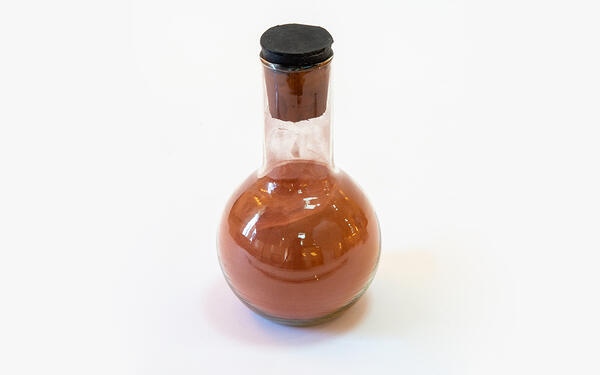
The exhibition of the Verkhnyaya Pyshma Historical Museum contains a glass flask with copper powder, which is closed with a ground stopper. It was made in 2013 at the local Uralelektromed plant, which was created on the basis of the Pyshminsky Copper Electrolytic Plant.
The production of copper powder in Verkhnyaya Pyshma was launched during the Great Patriotic War. The powder was used to produce parts for tank and aircraft engines. During the war, the Pyshminsky plant was the only enterprise in the country that produced this powder.
Copper powder is 99% copper and 1% impurities. They can be iron, tin, or lead. There are several ways to obtain powder from metal: under laboratory conditions, using chemical reactions, or mechanically, by crushing hot copper into small pieces.
There are different types of copper powder depending on the particle size, composition and grade. For example, only ultra-fine powder is suitable for the aerospace industry — its particle size does not exceed 100 nanometers, which is approximately equal to 0.0000001 millimeters, and the composition contains 99.99% copper.
The powder easily absorbs water, so it is stored in closed containers in dry, cool rooms. Most often, the powder is transported in closed railway wagons and is isolated from other chemical elements.
Metal powders have been used in everyday life for a long time. For example, crushed copper, silver and gold were added to dyes, which were used to paint ceramics and create pictures. Gradually, the scope of application expanded: nowadays, copper power is used in the production of cars, aircraft, and car tires, as well as in medicine. And in laboratories, the powder is used in some chemical reactions.
The exhibition of the Verkhnyaya Pyshma Historical Museum contains a glass flask with copper powder, which is closed with a ground stopper. It was made in 2013 at the local Uralelektromed plant, which was created on the basis of the Pyshminsky Copper Electrolytic Plant.
The production of copper powder in Verkhnyaya Pyshma was launched during the Great Patriotic War. The powder was used to produce parts for tank and aircraft engines. During the war, the Pyshminsky plant was the only enterprise in the country that produced this powder.
Copper powder is 99% copper and 1% impurities. They can be iron, tin, or lead. There are several ways to obtain powder from metal: under laboratory conditions, using chemical reactions, or mechanically, by crushing hot copper into small pieces.
There are different types of copper powder depending on the particle size, composition and grade. For example, only ultra-fine powder is suitable for the aerospace industry — its particle size does not exceed 100 nanometers, which is approximately equal to 0.0000001 millimeters, and the composition contains 99.99% copper.
The powder easily absorbs water, so it is stored in closed containers in dry, cool rooms. Most often, the powder is transported in closed railway wagons and is isolated from other chemical elements.
Metal powders have been used in everyday life for a long time. For example, crushed copper, silver and gold were added to dyes, which were used to paint ceramics and create pictures. Gradually, the scope of application expanded: nowadays, copper power is used in the production of cars, aircraft, and car tires, as well as in medicine. And in laboratories, the powder is used in some chemical reactions.