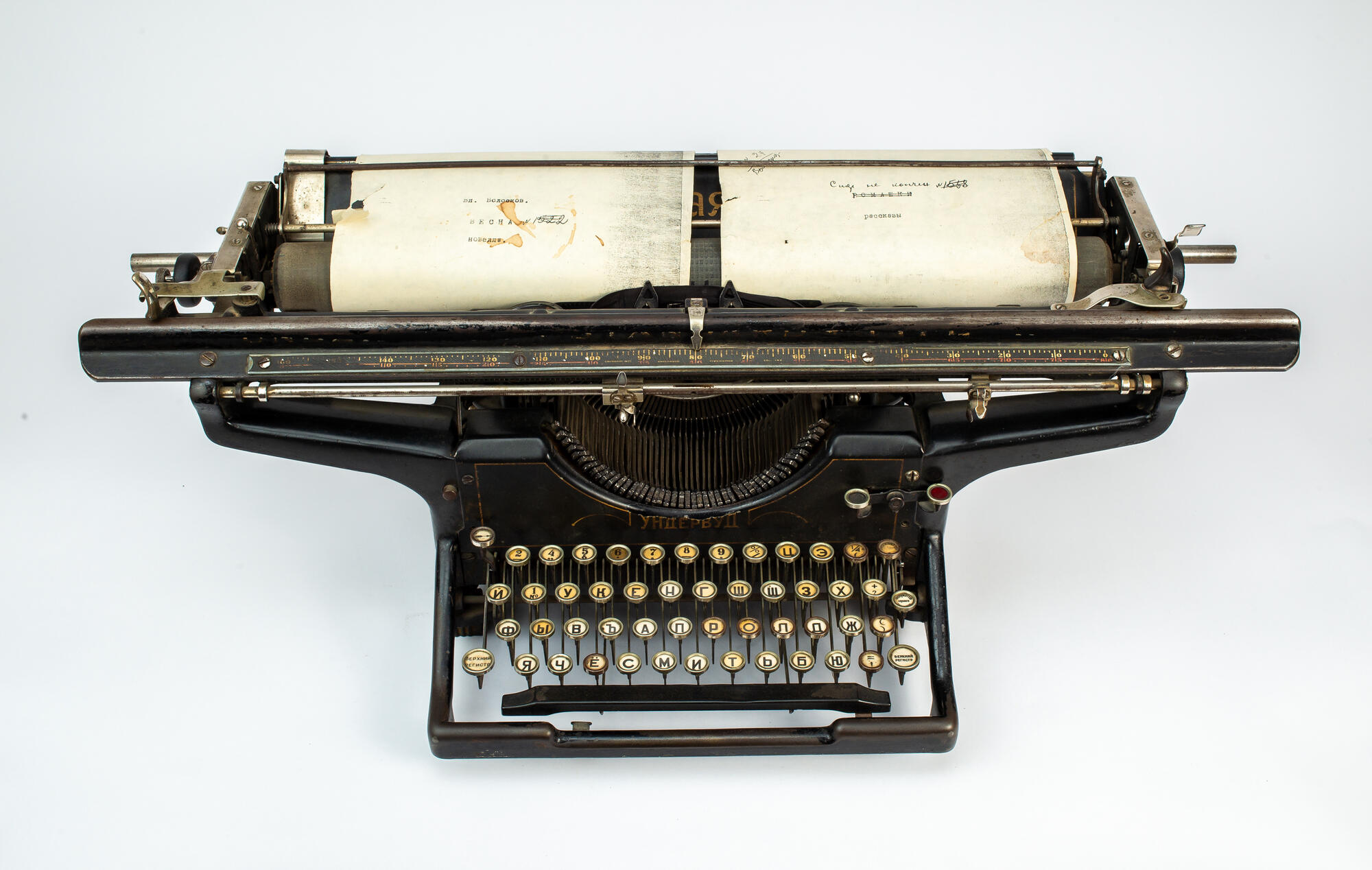


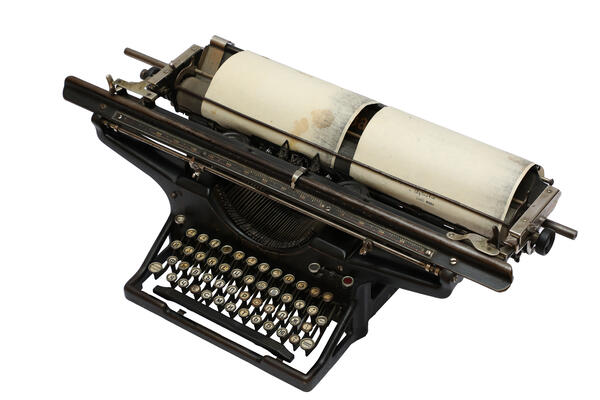
The American Underwood typewriter from the collection of the Verkhnyaya Pyshma Historical Museum belonged to the writer Vladimir Voloskov. It was given to him as a present by a group of hydrogeologists.
The production of the Underwood typewriter was launched in the 1890s at the Underwood factory founded by American entrepreneurs. Their firm was originally part of ‘Remington & Sons’, making typewriter ribbons and carbon paper. When the Underwoods decided to work on their own, they began to produce not only expendable supplies but the typing devices as well.
However, it was an American inventor of German origin Franz Wagner who came up with the design. The ability to see the text while typing was the main characteristic that set the device apart from the earlier models: previously, characters were typed inside, and to see the result, one had to raise a special carriage.
Wagner showed the model to entrepreneur John Underwood. The latter supported his idea and bought his invention. After a few years, competitors also began to produce devices in which the typist could see the characters as they were typed.
New typewriters quickly became popular: by the early 1930s, the Underwoods had sold two million devices, more than all other firms combined.
Then the Underwoods began to improve their typewriter and added a mechanism that enabled addition and subtraction operations — an analog of a modern calculator.
In the years before World War II, the Underwoods created the world’s largest typewriter — it was a promotional campaign for the company. The giant device was displayed in Atlantic City, New Jersey and attracted large crowds.
Typewriters were not produced in Russia, but they were common. This included the Underwood typewriter, which was used by scientists, journalists and writers. For example, Sergei Dovlatov called his notebooks ‘Solo on Underwood’. The title quotes ‘The Typewriter’ — a short composition of light music composed by conductor Leroy Anderson, who used the sounds of an actual typewriter.
The Underwood typewriter is no longer produced, and the remaining devices have become antiques, which are included in many collections. The devices are also on display in museums.
The production of the Underwood typewriter was launched in the 1890s at the Underwood factory founded by American entrepreneurs. Their firm was originally part of ‘Remington & Sons’, making typewriter ribbons and carbon paper. When the Underwoods decided to work on their own, they began to produce not only expendable supplies but the typing devices as well.
However, it was an American inventor of German origin Franz Wagner who came up with the design. The ability to see the text while typing was the main characteristic that set the device apart from the earlier models: previously, characters were typed inside, and to see the result, one had to raise a special carriage.
Wagner showed the model to entrepreneur John Underwood. The latter supported his idea and bought his invention. After a few years, competitors also began to produce devices in which the typist could see the characters as they were typed.
New typewriters quickly became popular: by the early 1930s, the Underwoods had sold two million devices, more than all other firms combined.
Then the Underwoods began to improve their typewriter and added a mechanism that enabled addition and subtraction operations — an analog of a modern calculator.
In the years before World War II, the Underwoods created the world’s largest typewriter — it was a promotional campaign for the company. The giant device was displayed in Atlantic City, New Jersey and attracted large crowds.
Typewriters were not produced in Russia, but they were common. This included the Underwood typewriter, which was used by scientists, journalists and writers. For example, Sergei Dovlatov called his notebooks ‘Solo on Underwood’. The title quotes ‘The Typewriter’ — a short composition of light music composed by conductor Leroy Anderson, who used the sounds of an actual typewriter.
The Underwood typewriter is no longer produced, and the remaining devices have become antiques, which are included in many collections. The devices are also on display in museums.