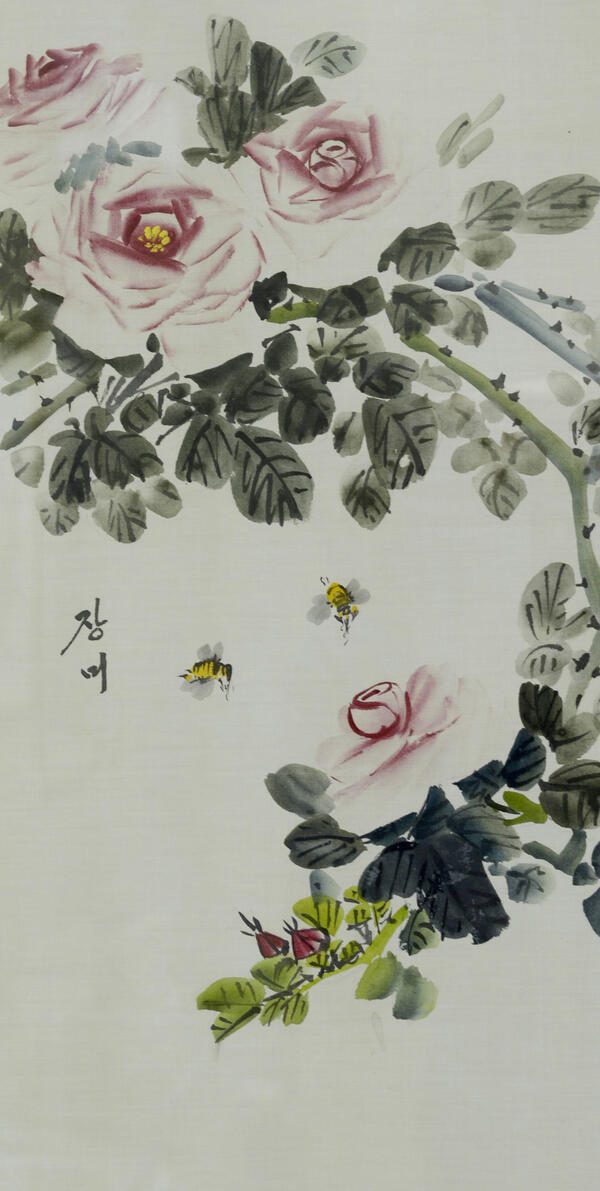
The scroll was donated to the Amur Regional Museum of Local Lore by the Korean delegation in May 1990 after the exhibition of decorative and applied arts by North Korean masters. This scroll depicts a curved branch of a blooming rose with red buds on a white background. The trunks of roses are covered with clearly drawn thorns, and the foliage has a bright rich and thick color. In the center are two flying bees with yellowish bodies and gray wings, and two hieroglyphs written in black. The picture is framed by a thin rectangular brown frame.
The first examples of Korean painting date back to the Bronze Age — they were rock carvings. Scientists find ancient tombs, completely covered with drawings, telling about various events from the life of the nobility as a continuation of earthly life in the afterlife with a family, servants, retinue. Then painting was divided into religious and everyday painting. Guardian spirits began to appear in it: a dragon, a tiger, a snake, a turtle.
Researchers agree that Korean painting acquired its individuality in 935-1392, during the reign of the Goryeo dynasty. A painting academy appeared, where the Korean nobility studied and created portraits and landscapes. Vertical and horizontal scrolls began to be used. The landscapes began to reflect the nature of their own country. For example, many artists painted the Diamond Mountains.
In Korean painting, there were southern and northern directions, slightly different from each other. The North with its school was under the influence of China. Color images were more common there, ceremonial rooms were decorated with such paintings, and artists of the south created monochrome works in ink or watercolors. Despite this style of painting, the southern masters were able to accurately convey several shades in their work.
The portraits of elderly people reflected the years lived, as prescribed by the philosophy of Confucianism. Such laconicism with strict lines, the so-called ‘boneless painting’ when the image had only outlines — all this has become a classic of Korean painting. Thus, artists conveyed the charm of nature and people’s feelings.
Artists used a brush with a long bristle, the work was created with ink or paints on thin paper or fabric, which easily and quickly absorbed them.
The first examples of Korean painting date back to the Bronze Age — they were rock carvings. Scientists find ancient tombs, completely covered with drawings, telling about various events from the life of the nobility as a continuation of earthly life in the afterlife with a family, servants, retinue. Then painting was divided into religious and everyday painting. Guardian spirits began to appear in it: a dragon, a tiger, a snake, a turtle.
Researchers agree that Korean painting acquired its individuality in 935-1392, during the reign of the Goryeo dynasty. A painting academy appeared, where the Korean nobility studied and created portraits and landscapes. Vertical and horizontal scrolls began to be used. The landscapes began to reflect the nature of their own country. For example, many artists painted the Diamond Mountains.
In Korean painting, there were southern and northern directions, slightly different from each other. The North with its school was under the influence of China. Color images were more common there, ceremonial rooms were decorated with such paintings, and artists of the south created monochrome works in ink or watercolors. Despite this style of painting, the southern masters were able to accurately convey several shades in their work.
The portraits of elderly people reflected the years lived, as prescribed by the philosophy of Confucianism. Such laconicism with strict lines, the so-called ‘boneless painting’ when the image had only outlines — all this has become a classic of Korean painting. Thus, artists conveyed the charm of nature and people’s feelings.
Artists used a brush with a long bristle, the work was created with ink or paints on thin paper or fabric, which easily and quickly absorbed them.