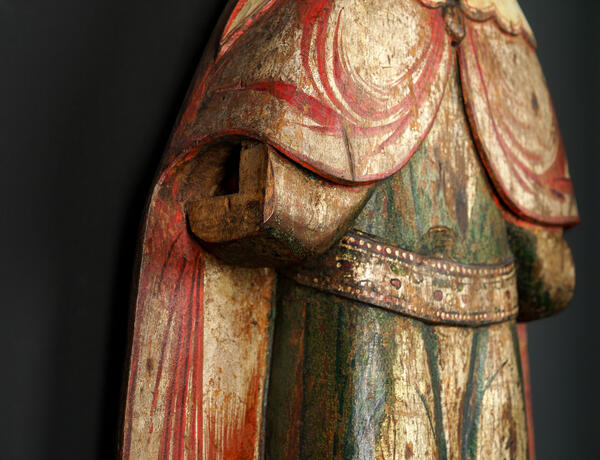
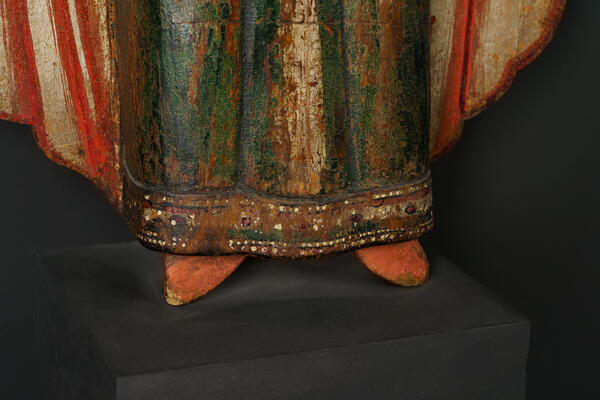
Old Russian reliefs are often depicted “flattened”, with volume conveyed by pictorial means. The backs of temple sculptures were often cut off to allow better connection to the back of a deep kiot, or ark (khramets), with a pointed top and side flaps.
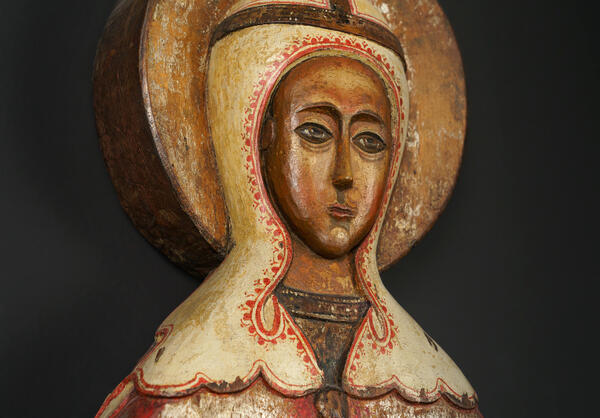
The statue of the Great Martyr Paraskeva Friday, presented in the Andrei Rublev Museum, was once held in such a kiot. Researchers date the sculpture to the turn of the 18th century, relying on the realism of the details. Unfortunately, some parts of the sculpture have been lost: the hands, the martyr’s cross, and the scroll with the text of the Creed.
Saint Paraskeva’s head is adorned with a crown with a cross, a symbol of martyrdom. According to tradition, Saint Paraskeva lived during the reign of Emperor Diocletian. She dedicated herself to the service of God from an early age and preached the Gospel. For her refusal to renounce her faith, Saint Paraskeva was tortured and severely beaten.
Carved images of the Great Martyr Paraskeva Friday were widely known in Russia in the Middle Ages. They were as popular as the wooden statues of Saint Nicholas of Mozhaisk.
In 1543, pilgrims from Lithuania brought to Pskov icon-statues “in arks” — the Great Martyr Paraskeva Friday and Saint Nicholas the Wonderworker. The people of Pskov arrested both the travelers and the statues they perceived as embarrassing. Only the order of the Novgorod Archbishop Macarius forced the townsfolk to respectfully “trade” the wooden icons, which were unprecedented for them, to carry them to the city and place them in specially built churches.
Saint Paraskeva, whose name means “Friday” in
Greek, was considered the patron saint of commerce (many Old Russian towns
traded on Fridays), as well as of handicrafts, needlework, and domesticity.
According to popular belief, the saint was associated with water sources, so
her statue was often placed in chapels and churches built near springs and therapeutic
waters. With their multicolored painting, the wooden statues bore a similarity
to icons and had an ornate appearance, typical of the medieval worldview.